Shopping Area Redevelopment
The question
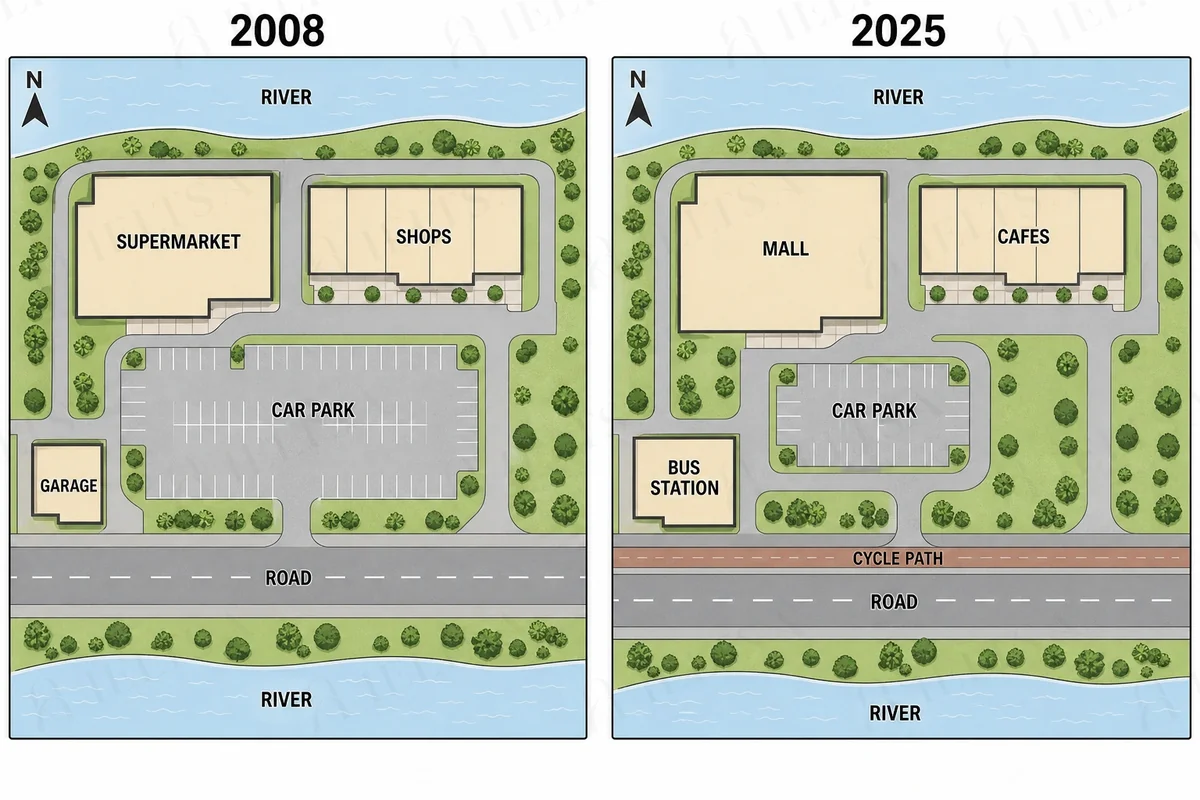
The maps below show a shopping area in 2008 and in 2025.
Summarise the information by selecting and reporting the main features, and make comparisons where relevant.
Write at least 150 words.
Instructions
You should spend about 20 minutes on this task.
• Begin with an overview of the main changes shown on the maps.
• Use location language such as to the north of, next to and in the south-east.
• Group the changes logically rather than describing every feature in turn.
• Do not give your own opinions.
How to approach this map question
A map question shows a place at two points in time (or two plans). Describe what changed, what stayed the same, and where, using direction and location language.
- Say what the maps show and the two time points in your own words.
- Overview: the main kind of change (for example more building, less green space) and one thing that stays.
- Describe changes area by area (north, south, centre) with verbs such as was replaced by, was converted into, was built.
- Use precise location phrases: to the east of, next to, opposite, in the north-west corner.
How to plan this answer
Structure
- Introduction: paraphrase the maps. The shopping area in 2008 and 2025.
- Overview: the supermarket and shops were redeveloped into a mall and cafes, the car park was reduced, and a bus station and cycle path were added, while the road and rivers stayed the same.
- Body 1: the north, where the supermarket became a mall and the shops became cafes.
- Body 2: the centre and south-west, where the car park was smaller, the garage became a bus station, and the cycle path was added.
Key features to spot
- The supermarket in the north-west was replaced by a larger mall on a similar site.
- The row of shops in the north-east was converted into a row of cafes.
- The car park in the centre became smaller, although it still has a large number of spaces.
- The garage in the south-west was replaced by a bus station.
- A cycle path was added alongside the road, and the road and the rivers on both sides remained unchanged.
Useful vocabulary
- was replaced by a larger: The supermarket was replaced by a larger mall.
- were converted into: The shops were converted into cafes.
- was reduced in size: The car park was reduced in size.
- in the south-west: The bus station is in the south-west of the area.
- a cycle path was added: A cycle path was added alongside the road.
- remained unchanged: The road and the rivers remained unchanged.
- to the north of the road: The cafes are to the north of the road.
- the most notable change: The most notable change is the new mall.
- alongside: The cycle path runs alongside the road.
- in the same position: The mall occupies the same position as the supermarket.
Common mistakes
- Saying the car park was removed. It was made smaller but still exists.
- Confusing the shops and the cafes. The shops became cafes in the north-east.
- Describing the garage as still standing. It was replaced by a bus station.
- Forgetting the new cycle path, which is one of the clearest additions on the 2025 map.
- Describing the rivers as changed. They stayed the same on both sides of the road.
Examiner tip: Start with the large redevelopment in the north, then move through the centre and south-west, and mention the unchanged road and rivers to frame the layout.
Model answers by band score
Written for this question to show what changes from one band to the next. Try the task yourself first, then compare.
Band 6 answer
The maps show a shopping area in 2008 and in 2025. Overall, the area change a lot, with new buildings and a smaller car park, but the road and the two rivers stay the same.
In 2008, there was a supermarket in the north-west of the area and a row of shops in the north-east. A big car park was in the middle, and a garage was in the south-west, near the car park. The road went from the west to the east in the south, and there were rivers in the north and the south.
By 2025, the supermarket has become a mall, and the shops have been changed into cafes. The car park is much smaller than before, so there is more green space in the middle and the east of the area. The garage has gone and there is a bus station in the same place, in the south-west. Also, a cycle path has been added beside the road, between the road and the shopping area.
Why this is band 6
- Gives a relevant overview and describes all the main changes, with location language such as 'in the north-west'.
- Information is accurate, but it is sequenced as a list of features and there is little grouping of changes.
- Verb forms and tense control slip ('the area change', 'stay the same'), though meaning is clear.
- To reach Band 7, it would group changes (buildings, car park, transport) and use more varied passive and location language.
Band 7 answer
The maps illustrate how a shopping area changed between 2008 and 2025.
Overall, the area has been modernised: the two main buildings have changed function, the car park has shrunk, and facilities for public transport and cyclists have been added. The road and the two rivers remain unchanged.
The two buildings in the north have been converted. The supermarket in the north-west has been replaced by a mall on the same site, and the row of shops in the north-east has been turned into cafes.
The most noticeable change is to the car park in the centre, which has been reduced to a much smaller area, leaving more green space to the south and east of it. In the south-west, the garage has been demolished and a bus station now stands in its place. Finally, a cycle path has been built along the road, running between the road and the shopping area, so the area now offers bus and cycling facilities as well as parking.
Why this is band 7
- The overview groups the changes (functions changed, car park smaller, transport added) and notes what stayed the same.
- Information is logically grouped into buildings, car park and transport, with clear location language ('in the north-west', 'to the south and east').
- Good range of passives ('has been converted', 'has been demolished') with only minor imprecision.
- To reach Band 8, it would use more precise detail (for example, where the cycle path lies and the extent of the green space) and smoother, more varied linking.
Band 8 answer
The two maps compare a shopping area in 2008 and 2025.
Overall, the site has been redeveloped to emphasise shopping and sustainable transport, with a considerably reduced car park. The road running east to west and the rivers to the north and south are the only features that remain untouched.
Both of the buildings in the northern half have changed use. The supermarket in the north-west corner has given way to a mall occupying the same position, and the parade of shops to its east has been converted into cafes without any change to the building's footprint.
Parking has been drastically curtailed. The large rectangular car park in the centre has been replaced by a far smaller one, with the freed land becoming open green space, particularly to the south and east of the remaining spaces. Meanwhile, transport provision has been reorganised: the garage in the south-west has been replaced by a bus station, and a cycle path has been laid along the northern edge of the road, separating cyclists from the traffic.
Why this is band 8
- The overview interprets the whole picture (shopping and sustainable transport, smaller car park) rather than listing features.
- Detail is precise and accurate, for example 'a cycle path ... along the northern edge of the road' and the shops being converted with the same footprint.
- Language is flexible and natural ('given way to', 'drastically curtailed'), with rare errors.
- To reach Band 9, it would make the sequence of changes and spatial relationships still more effortless, with no slightly clumsy phrasing.
Band 9 answer
The two maps show a shopping area as it was in 2008 and as it is in 2025.
Overall, the layout has been retained but its character has changed: the main buildings have new functions, the car park has been drastically reduced, and provision for buses and cyclists has been introduced. The road and the rivers to the north and south are unchanged.
In the northern half, the two buildings have simply been repurposed. The supermarket in the north-west corner is now a mall on the same site, and the row of shops to its east has become a row of cafes.
The reshaping of the southern half is more dramatic. The large rectangular car park that dominated the centre has been replaced by a much smaller one, and the land it released has been turned into green space, which now extends to the east and south of the remaining spaces. In the south-west corner, a bus station has taken over the plot formerly occupied by the garage, and a cycle path now runs alongside the road, just to its north, separating cyclists from the traffic.
Why this is band 9
- The overview captures both what has stayed (layout, road, rivers) and what has changed, in a single natural sentence.
- Each spatial relationship is accurate and economical (north-west corner, east of it, just north of the road).
- Sophisticated, essentially error-free language with flexible passives and varied sentence structures.
- Grouping by northern and southern halves makes the cohesion natural and the whole description easy to follow.
Band levels are our estimate against the public IELTS criteria; they are not official scores.
Write your answer
Sign in with Google to write online and get 8 free answers marked each month against the IELTS band criteria. No card, no password.
Sign in with Google to writeMore practice questions
Practise all four IELTS skills
Listening, Reading, Writing and Speaking with band 8 samples at ieltsa.org.