Children Walking or Cycling to School
The question
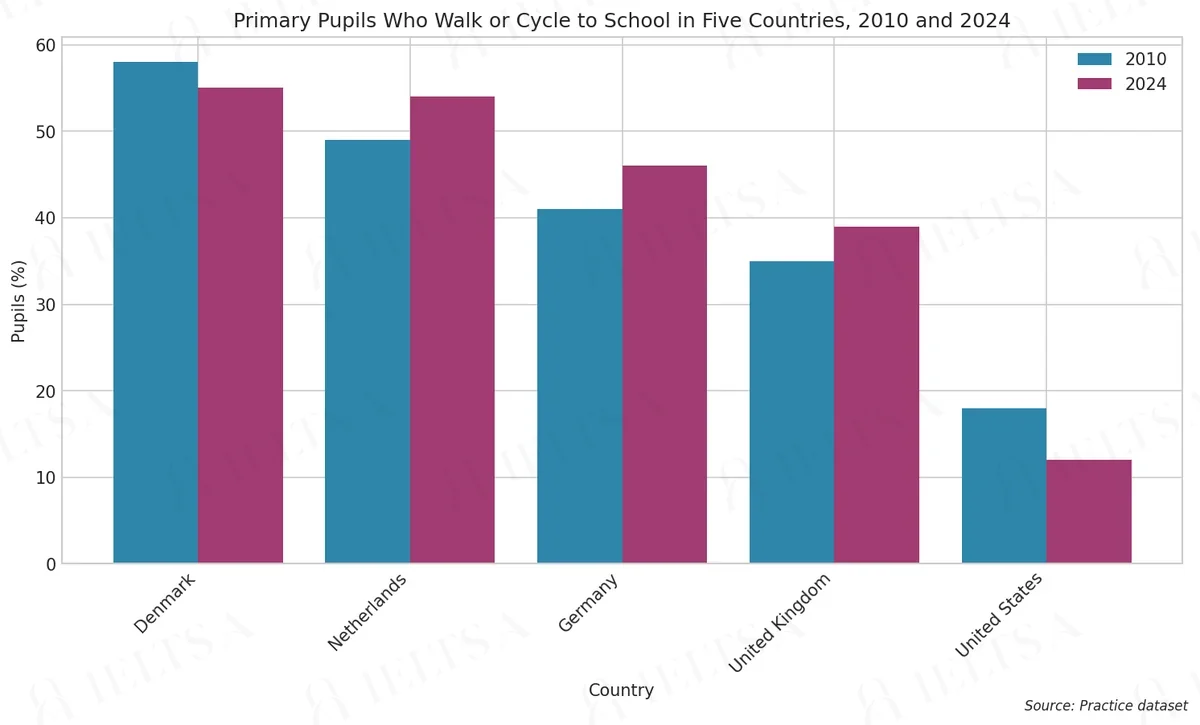
The bar chart below shows the percentage of primary school pupils who walked or cycled to school in five countries in 2010 and 2024. Summarise the information by selecting and reporting the main features, and make comparisons where relevant.
Write at least 150 words.
Instructions
You should spend about 20 minutes on this task.
• Begin with an overview of the main trends or differences.
• Compare the countries with each other as well as over time.
• Use the figures and units shown on the chart where they help.
• Do not give your own opinions or speculate about causes.
How to approach this bar chart question
A bar chart compares categories or shows change between points in time. Write an overview of the biggest differences, then compare the highest, lowest and any surprise.
- Name the chart, the units and the time or places it covers in one sentence (paraphrase the question).
- Write an overview: the largest and smallest categories, or the main change over time.
- Group the bars into two body paragraphs by similarity, not one by one.
- Quote the key numbers only, with units, and compare them.
How to plan this answer
Structure
- Introduction: paraphrase the chart. Percentage of primary pupils walking or cycling to school in five countries, 2010 and 2024.
- Overview: Denmark had the highest figure in both years, the United States had the lowest, and the Netherlands, Germany and the UK all rose.
- Body 1: Denmark (58 to 55) and the Netherlands (49 to 54), noting how the gap between them narrowed.
- Body 2: Germany (41 to 46), the UK (35 to 39) and the United States (18 to 12), which fell most sharply in percentage points.
Key features to spot
- Denmark led in both years, although its figure fell slightly from 58 per cent to 55 per cent.
- The gap between Denmark and the Netherlands narrowed from 9 percentage points in 2010 to only 1 in 2024.
- The Netherlands and Germany each rose by 5 percentage points, from 49 to 54 and from 41 to 46.
- The United States was lowest in both years, and its figure fell by 6 percentage points, from 18 to 12.
- The UK rose by 4 percentage points, from 35 to 39, placing it fourth in both years.
Useful vocabulary
- the proportion of pupils who walked or cycled: The chart shows the proportion of pupils who walked or cycled to school.
- remained the highest: Denmark remained the highest in both years.
- percentage points: The figure for the United States fell by six percentage points.
- narrowed: The gap between Denmark and the Netherlands narrowed considerably.
- rose by five percentage points: Germany rose by five percentage points over the period.
- the lowest figure: The United States recorded the lowest figure in both years.
- a slight decline: Denmark showed a slight decline, from 58 to 55 per cent.
- the same ranking: The five countries kept the same ranking from 2010 to 2024, although the Netherlands closed in on Denmark.
- fell most sharply: The United States fell most sharply of all five countries.
- in both years: Denmark was the top country in both years.
Common mistakes
- Describing changes in percentage points as per cent. A rise from 49 to 54 is five percentage points, not a 5 per cent increase.
- Saying the United States rose or was stable. Its figure fell from 18 to 12, so it declined.
- Presenting Denmark's fall of three points as a large drop. It is a slight decline.
- Stating that the Netherlands overtook Denmark. In 2024 Denmark (55) is still slightly ahead of the Netherlands (54).
- Giving a reason for the rises, such as cycle lanes or school policy. The task does not ask for causes.
Examiner tip: Use percentage points for the changes and check that the ranking you describe matches both years, especially the close Denmark and Netherlands figures in 2024.
Write your answer
Sign in with Google to write online and get 8 free answers marked each month against the IELTS band criteria. No card, no password.
Sign in with Google to writeMore practice questions
Practise all four IELTS skills
Listening, Reading, Writing and Speaking with band 8 samples at ieltsa.org.