Paper Recycling Process
The question
The diagram below shows how paper is recycled.
Summarise the information by selecting and reporting the main features, and make comparisons where relevant.
Write at least 150 words.
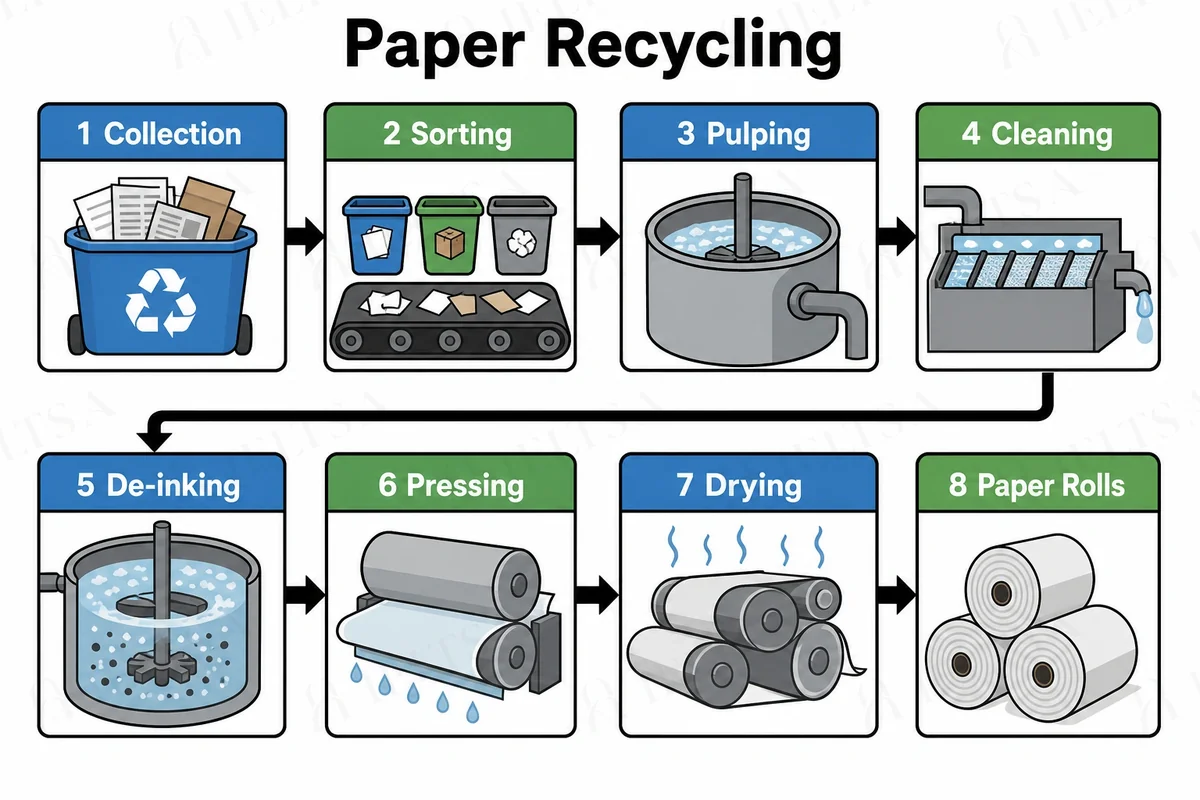
Instructions
You should spend about 20 minutes on this task.
• Begin with an overview: say how many stages there are and where the process starts and ends.
• Describe the stages in order, using sequence words such as first, then, after that and finally.
• Use the passive voice where suitable and do not give your own opinions.
• State the first and last stages in your overview.
How to approach this process diagram question
A process diagram shows how something is made or how a cycle works. Describe the stages in order, using sequence language and the passive voice.
- Say what process the diagram shows and how many stages it has.
- Overview: the number of stages, where it starts and ends, and whether it is a cycle or a straight line.
- Describe every stage in order (First, Next, After that, Finally) mostly in the passive: the grain is crushed.
- Do not add opinions or explain why; describe what happens.
How to plan this answer
Structure
- Overview: the diagram shows eight stages in two rows, starting with collection and ending with paper rolls.
- Body 1: the first row, covering collection, sorting, pulping and cleaning.
- Body 2: the second row, covering de-inking, pressing, drying and paper rolls, and the arrow linking the rows.
Key features to spot
- Waste paper is collected in a large blue bin with the recycling symbol.
- The paper is sorted into three bins: blue for paper, green for cardboard and grey for other waste.
- The paper is pulped in a large tank of water, which breaks it into a mixture.
- The pulp is cleaned as it passes over screens, and then the ink is removed in a de-inking tank.
- The pulp is pressed between rollers and dried on heated rollers before it is rolled into paper rolls.
Useful vocabulary
- is collected: Waste paper is collected in a bin.
- is sorted into: The paper is sorted into three bins.
- is pulped: The paper is pulped in a tank of water.
- is cleaned: The pulp is cleaned as it passes over screens.
- is de-inked: The pulp is de-inked to remove the ink.
- is pressed: The paper is pressed between rollers.
- is dried: The paper is dried on heated rollers.
- are rolled: The finished paper is rolled into large rolls.
- is followed by: Pulping is followed by cleaning.
- the final stage: The final stage is the production of paper rolls.
Common mistakes
- Putting drying before pressing. Pressing is stage six and drying is stage seven.
- Describing the paper as shredded. The diagram shows pulping, not shredding.
- Confusing cleaning and de-inking. Cleaning is stage four, while de-inking is stage five.
- Leaving out the number of stages. Say that there are eight stages in two rows.
- Mixing up the sorting bins. The blue bin holds paper, the green bin cardboard and the grey bin other waste.
Examiner tip: Give the total of eight stages and the start and end points in your overview, then describe each row in order, linking them with the arrow between the two rows.
Model answers by band score
Written for this question to show what changes from one band to the next. Try the task yourself first, then compare.
Band 6 answer
The diagram show how paper is recycle in eight stages. It start with collection and finish with paper rolls.
First, the used paper is collected in a big recycling bin. Then, it is sorting into different types, such as newspaper and card, on a conveyor belt. After that, the paper goes to a big tank and it is made into pulp with water. This is the third stage.
The fourth stage is cleaning. The pulp is cleaned in a machine and the water is taken out. Next, in stage five, the ink is removed from the pulp in a second tank, this is called de-inking. After that, the pulp is pressed by two big rollers and the water drops down from it.
Then the paper is dried. In this stage it is heated and the steam goes up. Finally, the dry paper is made into big paper rolls, and these are ready to use. In total the process have eight stages and all of them are in a line.
Why this is band 6
- Covers all eight stages in the right order with sequence words (first, then, after that, finally), so the task is achieved.
- Overview is basic (number of stages, start and end) and some details are loosely stated, such as 'the water is taken out' in cleaning.
- Grammar errors affect accuracy ('The diagram show', 'is recycle', 'it is sorting', 'process have') and the sequence words are repetitive.
- Band 7 would use the passive consistently, vary linking more and describe what each stage does more precisely.
Band 7 answer
The diagram illustrates how used paper is recycled. There are eight stages in total, beginning with the collection of waste paper and ending with the production of rolls of new paper.
At the first stage, used paper is collected in recycling bins. It is then sorted on a conveyor belt, where different types, such as newspapers, card and other materials, are separated into containers. After sorting, the paper is mixed with water in a large tank and broken down into pulp.
In the fourth stage, the pulp passes through a cleaning machine, which filters it and removes water. The cleaned pulp is then transferred to another tank, where it is stirred so that the ink can be removed. This is known as de-inking.
Next, the pulp is pressed between rollers, which squeeze out most of the remaining water. The paper is dried by heated rollers, and finally it is wound into large rolls, ready to be used again.
Why this is band 7
- Clear overview stating the number of stages and the first and last stages, as the task requires.
- Stages are explained in order with a mostly accurate use of the passive ('is collected', 'is sorted') and sequence markers such as 'then' and 'after sorting'.
- Range is good and errors are few; descriptions of what the machines do go beyond a simple list.
- Band 8 would avoid slight overstatement (the picture does not show a filter by name or heated rollers) and vary sentence structure and linking more flexibly.
Band 8 answer
The diagram shows the eight stages of paper recycling, from the collection of used paper to the production of finished rolls.
The process begins with collection, when waste paper is gathered in recycling bins. At the second stage, it is sorted on a conveyor belt, which separates the material into different types. The sorted paper is then pulped: it is mixed with water in a large tank and agitated until it breaks down into a soft mass.
Once pulped, the material is cleaned in a machine that passes the mixture over a series of screens, and water drains away at the end. After that, the pulp is de-inked in a second tank, where it is stirred in water so that particles of ink separate from the fibres.
In the final three stages, the pulp is pressed between two large rollers to squeeze out water, dried with heat, and finally wound into rolls. Overall, the process moves in a single direction from raw, mixed waste to uniform rolls of paper that can be reused.
Why this is band 8
- The overview states the number of stages and the start and end points, and closes by summarising the one-directional nature of the process.
- Each stage has a precise verb and a purpose ('agitated until it breaks down', 'ink separate from the fibres'), derived from the picture, rather than just a label.
- Passive voice is used accurately and cohesion is natural ('Once pulped', 'In the final three stages').
- Band 9 would keep the same level of detail with even more economy and fewer connecting phrases that merely repeat the order.
Band 9 answer
The diagram illustrates how waste paper is turned into new paper rolls in eight consecutive stages, beginning with collection and ending with the finished product.
First, used paper is gathered in recycling bins. It is then sorted by type on a conveyor belt, so that newspapers, card and other materials can be processed separately. The sorted material is next pulped, being mixed with water in a large tank and churned into a fibrous slurry.
The slurry is subsequently cleaned in a machine in which it flows across a set of screens while the water drains away. It then enters a second tank, where it is stirred again to detach the ink from the fibres, a stage known as de-inking.
The remaining stages remove water and shape the product. The pulp is pressed between two heavy rollers, which squeeze out most of the moisture before the sheet is dried with heat. Finally, the dried paper is wound into large rolls. In this way, a mixed collection of used paper emerges at the end as a uniform material that is ready for reuse.
Why this is band 9
- Overview gives the number of stages and both endpoints, and the final sentence gives a purposeful summary of what the process achieves.
- Verbs are precise and varied ('churned', 'detach', 'drains away', 'emerges'), and the passive is used naturally without monotony.
- Everything described is visible in the diagram, with no invented detail, and the three body paragraphs group the stages logically (preparation, purification, shaping).
- Grammar and spelling are error-free and cohesion is seamless.
Band levels are our estimate against the public IELTS criteria; they are not official scores.
Write your answer
Sign in with Google to write online and get 8 free answers marked each month against the IELTS band criteria. No card, no password.
Sign in with Google to writeMore practice questions
Practise all four IELTS skills
Listening, Reading, Writing and Speaking with band 8 samples at ieltsa.org.