Cheese Making
The question
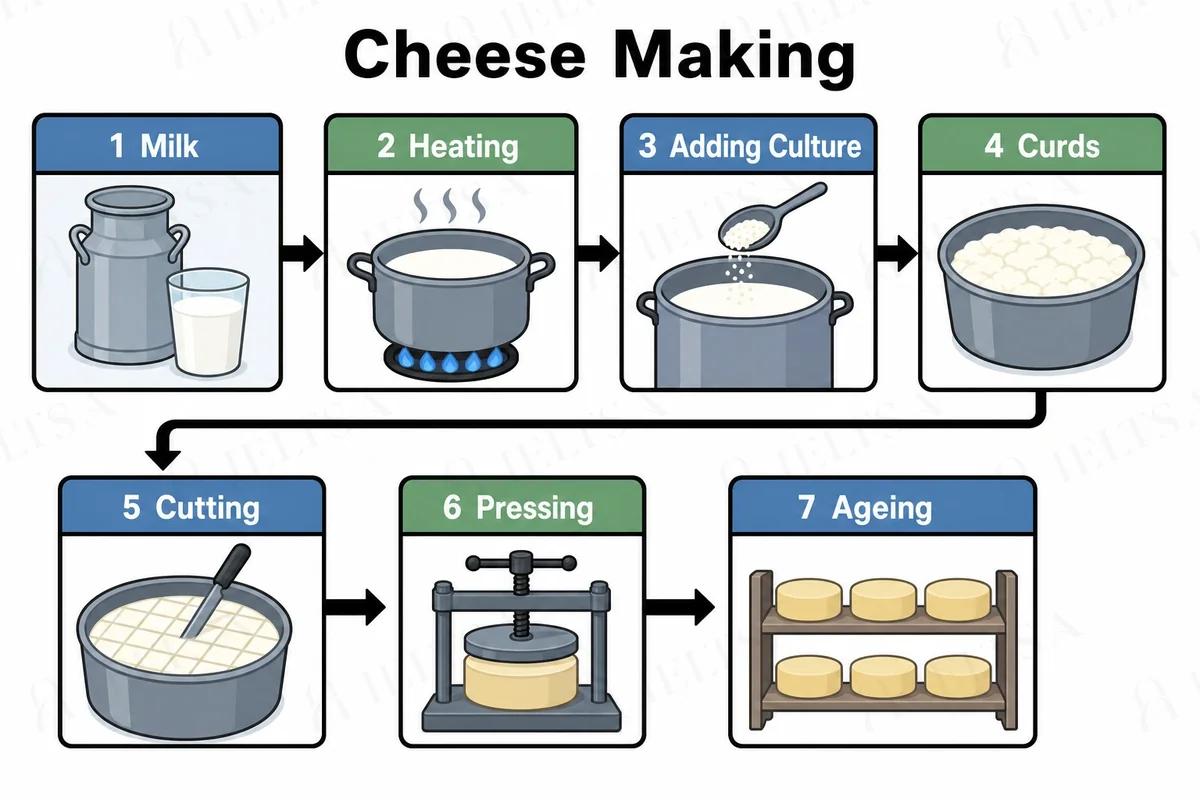
The diagram below shows how cheese is made.
Summarise the information by selecting and reporting the main features, and make comparisons where relevant.
Write at least 150 words.
Instructions
You should spend about 20 minutes on this task.
• Begin with an overview: say how many stages there are and where the process starts and ends.
• Describe the stages in order, using sequence words such as first, then, after that and finally.
• Use the passive voice where suitable and do not give your own opinions.
• State the first and last stages in your overview.
How to approach this process diagram question
A process diagram shows how something is made or how a cycle works. Describe the stages in order, using sequence language and the passive voice.
- Say what process the diagram shows and how many stages it has.
- Overview: the number of stages, where it starts and ends, and whether it is a cycle or a straight line.
- Describe every stage in order (First, Next, After that, Finally) mostly in the passive: the grain is crushed.
- Do not add opinions or explain why; describe what happens.
How to plan this answer
Structure
- Overview: state that cheese is made in seven stages, starting with milk and ending with ageing, arranged in two rows.
- Paragraph 2: describe the first four stages (milk, heating, adding culture and curds), noting the change from liquid milk to solid curds.
- Paragraph 3: describe the remaining three stages (cutting, pressing and ageing) and where the sequence moves from the top row to the bottom row.
- No conclusion paragraph is needed beyond a one-line summary in the overview.
Key features to spot
- Stage 1 is milk, shown as a metal churn with a glass beside it, so the process starts with raw milk rather than any prepared ingredient.
- Stage 2 is heating, where milk in a pot is placed over a gas flame until it is warm.
- Stage 3 is adding culture, where a spoonful of powdered starter is sprinkled into the warm milk.
- Stage 4 is curds, a bowl of soft white lumps that form as the milk separates.
- Stage 5 is cutting, where a knife slices the curds into a grid pattern in a tub, and stage 6 is pressing, where a mould is placed under a press to remove liquid.
- Stage 7 is ageing, where the cheese wheels are stored on wooden shelves, and this final stage is the end of the process.
Useful vocabulary
- is heated until: The milk is heated until it reaches the required temperature.
- is added to: A starter culture is added to the warm milk.
- separate into: The milk separates into curds and whey after the culture is added.
- are cut into: The curds are cut into small pieces with a long knife.
- are placed in: The cut curds are placed in a mould before pressing.
- is pressed to: The curds are pressed to remove excess liquid.
- are left to age: The cheese wheels are left to age on wooden shelves.
- is followed by: Heating is followed by the addition of the culture.
- the sequence continues with: After the curds form, the sequence continues with cutting.
- the final stage: The final stage is ageing, which takes place on shelves.
Common mistakes
- Describing the curds as a separate ingredient, rather than the result of the culture acting on the heated milk.
- Naming the stage 'heating' as the cooking of the cheese; the diagram shows only that the milk is warmed in a pot.
- Missing the link between the two rows, which means the reader cannot see that stage 4 leads down to stage 5.
- Describing the ageing stage in vague terms such as 'something happens to the cheese', instead of naming the shelves and wheels shown.
- Adding information about flavour or taste, which is not part of the diagram and is not required by the task.
Examiner tip: Name the stages in order with a clear connector such as 'once the curds have formed' so the sequence reads naturally across the two rows.
Write your answer
Sign in with Google to write online and get 8 free answers marked each month against the IELTS band criteria. No card, no password.
Sign in with Google to writeMore practice questions
Practise all four IELTS skills
Listening, Reading, Writing and Speaking with band 8 samples at ieltsa.org.