Coffee Processing
The question
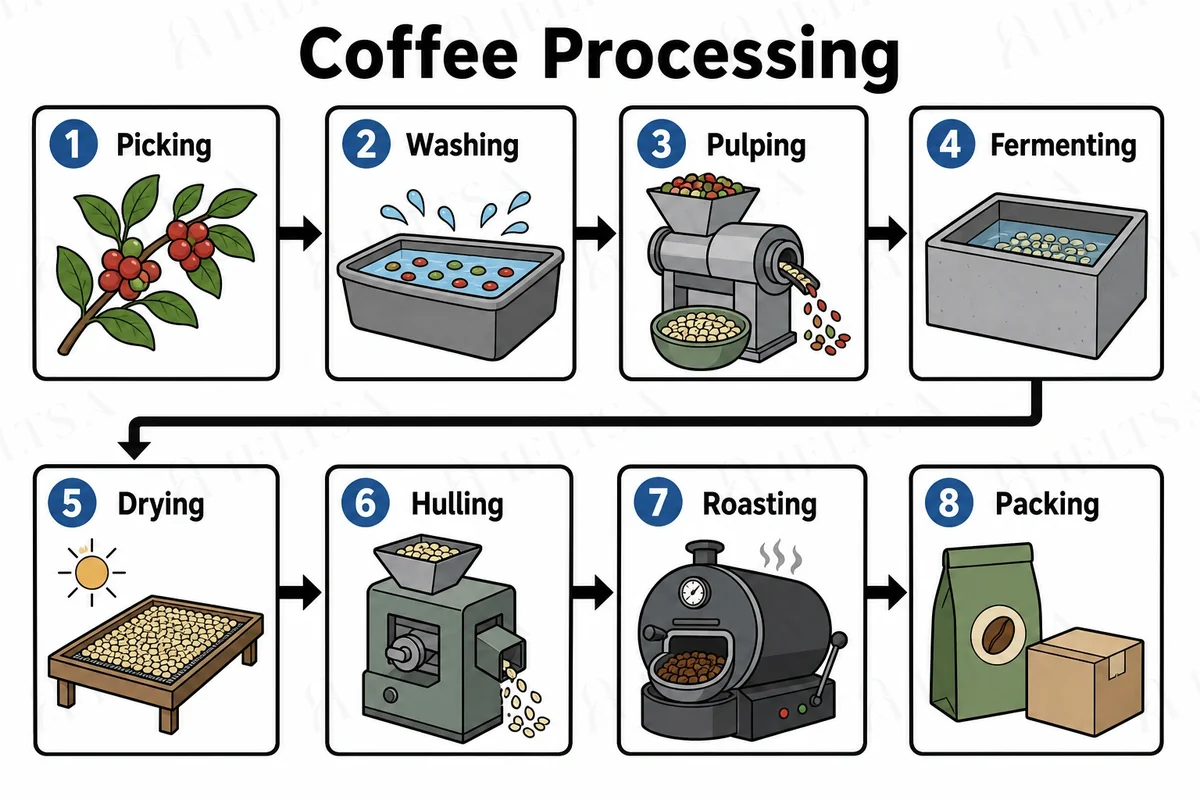
The diagram below shows how coffee beans are processed.
Summarise the information by selecting and reporting the main features, and make comparisons where relevant.
Write at least 150 words.
Instructions
You should spend about 20 minutes on this task.
• Begin with an overview: say how many stages there are and where the process starts and ends.
• Describe the stages in order, using sequence words such as first, then, after that and finally.
• Use the passive voice where suitable and do not give your own opinions.
• State the first and last stages in your overview.
How to approach this process diagram question
A process diagram shows how something is made or how a cycle works. Describe the stages in order, using sequence language and the passive voice.
- Say what process the diagram shows and how many stages it has.
- Overview: the number of stages, where it starts and ends, and whether it is a cycle or a straight line.
- Describe every stage in order (First, Next, After that, Finally) mostly in the passive: the grain is crushed.
- Do not add opinions or explain why; describe what happens.
How to plan this answer
Structure
- Overview: state that coffee beans are processed in eight stages, from picking to packing, arranged in two rows.
- Paragraph 2: describe the first four stages (picking, washing, pulping and fermenting), with the physical changes at each point.
- Paragraph 3: describe the remaining four stages (drying, hulling, roasting and packing) and how the sequence moves down to the second row.
- A closing line about the final stage of packing is enough.
Key features to spot
- Stage 1 is picking, shown as a branch with red and green berries, so the process begins with harvesting the fruit from the plant.
- Stage 2 is washing, where the berries are placed in a tank of water, which is shown with splashes around it.
- Stage 3 is pulping, where a machine with a hopper removes the outer fruit from the beans, which are then collected in a bowl.
- Stage 4 is fermenting, where the beans are left in a concrete tank of water for a period before the next stage.
- Stage 5 is drying, where the beans are spread on a raised wooden frame under the sun, and stage 6 is hulling, where a machine removes the outer husk.
- Stage 7 is roasting in a metal drum with a thermometer, and stage 8 is packing, where roasted beans are sealed in a green bag with a box beside it.
Useful vocabulary
- are picked from: The ripe berries are picked from the branches by hand.
- are washed in: The berries are washed in a tank of water.
- are pulped to: The berries are pulped to remove the outer fruit.
- are left to ferment: The beans are left to ferment in a tank for several days.
- are spread out to: The beans are spread out to dry on a raised frame.
- are hulled to: The dried beans are hulled to remove the husk.
- are roasted in: The beans are roasted in a metal drum until they darken.
- are sealed in: The roasted beans are sealed in bags for sale.
- is followed by: Pulping is followed by fermenting in a tank.
- the sequence moves to: After fermenting, the sequence moves to the drying stage in the second row.
Common mistakes
- Confusing pulping with washing, or saying the beans are washed after the roasting stage, which reverses the order shown.
- Describing the sun in the drying stage as a separate stage; it is a feature of the drying process, not a step of its own.
- Omitting the thermometer and the roasting drum detail, which gives the reader the clearest picture of the roasting stage.
- Treating the box and the bag in the packing stage as two separate products rather than the packed coffee.
- Stating that the process takes a particular number of days; the diagram gives no time periods, so none should be invented.
Examiner tip: Describe each machine or container by its shape and function, and use the passive for every action so the eight stages read as one logical sequence.
Write your answer
Sign in with Google to write online and get 8 free answers marked each month against the IELTS band criteria. No card, no password.
Sign in with Google to writeMore practice questions
Practise all four IELTS skills
Listening, Reading, Writing and Speaking with band 8 samples at ieltsa.org.