Desalination of Seawater
The question
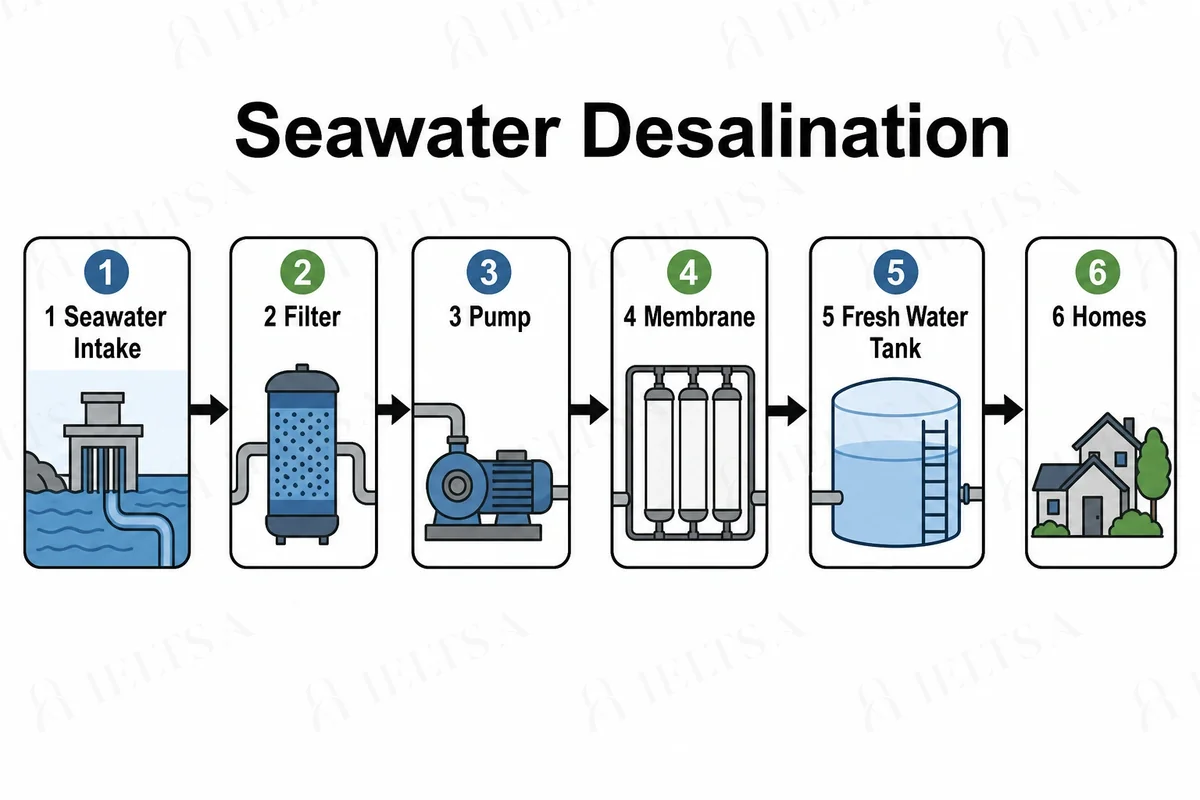
The diagram below shows how seawater is turned into drinking water at a desalination plant.
Summarise the information by selecting and reporting the main features, and make comparisons where relevant.
Write at least 150 words.
Instructions
You should spend about 20 minutes on this task.
• Begin with an overview: say how many stages there are and where the process starts and ends.
• Describe the stages in order, using sequence words such as first, then, after that and finally.
• Use the passive voice where suitable and do not give your own opinions.
• State the first and last stages in your overview.
How to approach this process diagram question
A process diagram shows how something is made or how a cycle works. Describe the stages in order, using sequence language and the passive voice.
- Say what process the diagram shows and how many stages it has.
- Overview: the number of stages, where it starts and ends, and whether it is a cycle or a straight line.
- Describe every stage in order (First, Next, After that, Finally) mostly in the passive: the grain is crushed.
- Do not add opinions or explain why; describe what happens.
How to plan this answer
Structure
- Overview: say there are six stages in a single row, starting with seawater intake and ending with homes.
- Paragraph 2: describe the early stages (intake, filtering and pumping) in order, using passive verbs such as is drawn in and is passed through.
- Paragraph 3: describe the later stages (membrane, freshwater tank and delivery to homes), noting that the water is stored before it reaches consumers.
- A short closing sentence summarising that the process moves in one direction is sufficient.
Key features to spot
- Stage 1 is a seawater intake structure at the shoreline, which draws water in from the sea before any treatment begins.
- Stage 2 is a filter, a cylindrical vessel with a perforated inner layer, which removes solid particles from the water.
- Stage 3 is a pump with a motor, which pressurises the water so that it can be forced through the membranes.
- Stage 4 shows three membrane units arranged in parallel, which separate the salt from the water.
- Stage 5 is a fresh water tank, shown as a large cylinder with a ladder, where treated water is stored.
- Stage 6 is homes, which means the final output is water for domestic use rather than an industrial product.
Useful vocabulary
- is drawn in from: Seawater is drawn in from the sea through an intake structure.
- is passed through: The water is passed through a filter to remove solid particles.
- is pressurised by: The water is pressurised by a pump before it reaches the membranes.
- is forced through: The pressurised water is forced through the membranes, which remove the salt.
- is stored in: Treated water is stored in a large tank before distribution.
- is then piped to: The fresh water is then piped to homes.
- in a single line: The six stages are arranged in a single line from intake to homes.
- the first stage: The first stage is the seawater intake, located at the coast.
- before it reaches: The water is stored before it reaches the consumers.
- the process begins with: The process begins with the collection of seawater from the sea.
Common mistakes
- Calling the membrane stage a filter, or merging stages 2 and 4 into one description, which loses the two-step treatment shown in the diagram.
- Stating that the pump removes salt; the diagram shows the pump moving the water, while the membrane is the stage that separates the salt.
- Omitting the freshwater tank because it appears to be only storage, although it is a distinct stage with its own position in the sequence.
- Giving the number of membranes as a different figure from the three shown.
- Describing the homes stage as a 'consumer' or 'customer' stage, rather than simply stating that water reaches homes.
Examiner tip: Use the passive voice for each treatment step and keep the six stages in their numbered order; a single clear paragraph for the early stages and one for the later stages is enough.
Write your answer
Sign in with Google to write online and get 8 free answers marked each month against the IELTS band criteria. No card, no password.
Sign in with Google to writeMore practice questions
Practise all four IELTS skills
Listening, Reading, Writing and Speaking with band 8 samples at ieltsa.org.