Recycling Plastic Bottles
The question
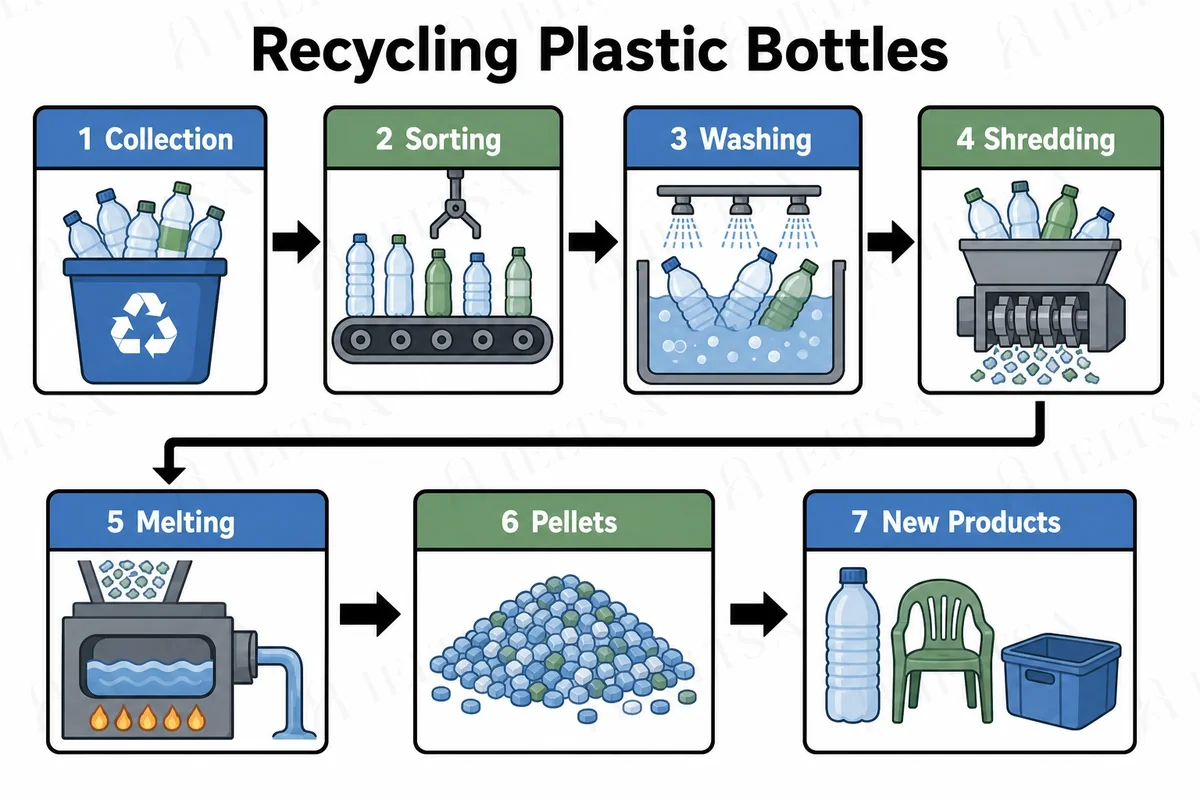
The diagram below shows how plastic bottles are recycled.
Summarise the information by selecting and reporting the main features, and make comparisons where relevant.
Write at least 150 words.
Instructions
You should spend about 20 minutes on this task.
• Begin with an overview: say how many stages there are and where the process starts and ends.
• Describe the stages in order, using sequence words such as first, then, after that and finally.
• Use the passive voice where suitable and do not give your own opinions.
• State the first and last stages in your overview.
How to approach this process diagram question
A process diagram shows how something is made or how a cycle works. Describe the stages in order, using sequence language and the passive voice.
- Say what process the diagram shows and how many stages it has.
- Overview: the number of stages, where it starts and ends, and whether it is a cycle or a straight line.
- Describe every stage in order (First, Next, After that, Finally) mostly in the passive: the grain is crushed.
- Do not add opinions or explain why; describe what happens.
How to plan this answer
Structure
- Overview: the diagram shows seven stages in two rows, starting with collection and ending with new products made from recycled bottles.
- Body 1: the first row, with collection, sorting, washing and shredding, in order from left to right.
- Body 2: the second row, with melting, pelletising and new products, and the arrow that links the two rows.
Key features to spot
- Bottles are collected in a blue recycling bin with the recycling symbol on it.
- On a conveyor belt, the bottles are sorted, with clear and green bottles separated.
- The bottles are washed in a tank of water, with sprays above.
- The bottles are shredded into small flakes, which are then melted.
- The melted plastic forms pellets, which are used to make new products such as bottles, a chair and a storage box.
Useful vocabulary
- are collected: The bottles are collected in a recycling bin.
- are sorted: The bottles are sorted on a conveyor belt.
- are washed: The bottles are washed in a tank of water.
- are shredded: The bottles are shredded into small pieces.
- are melted down: The flakes are melted down.
- are formed into: The melted plastic is formed into pellets.
- are then used to make: The pellets are then used to make new products.
- from left to right: The first row is read from left to right.
- is followed by: Shredding is followed by melting.
- the final stage: The final stage is the production of new products.
Common mistakes
- Placing shredding before washing. Washing comes third and shredding fourth.
- Putting melting before sorting. Melting appears in the second row, after shredding.
- Missing the link between the two rows. The arrow from the end of row one leads to melting.
- Stating only one new product. The diagram shows three products.
- Writing about why people recycle. The task does not ask for opinions.
Examiner tip: State the seven stages and the start and end points in your overview, then describe the two rows in order, using the arrow between them as the bridge.
Write your answer
Sign in with Google to write online and get 8 free answers marked each month against the IELTS band criteria. No card, no password.
Sign in with Google to writeMore practice questions
Practise all four IELTS skills
Listening, Reading, Writing and Speaking with band 8 samples at ieltsa.org.