Sugar from Sugar Cane
The question
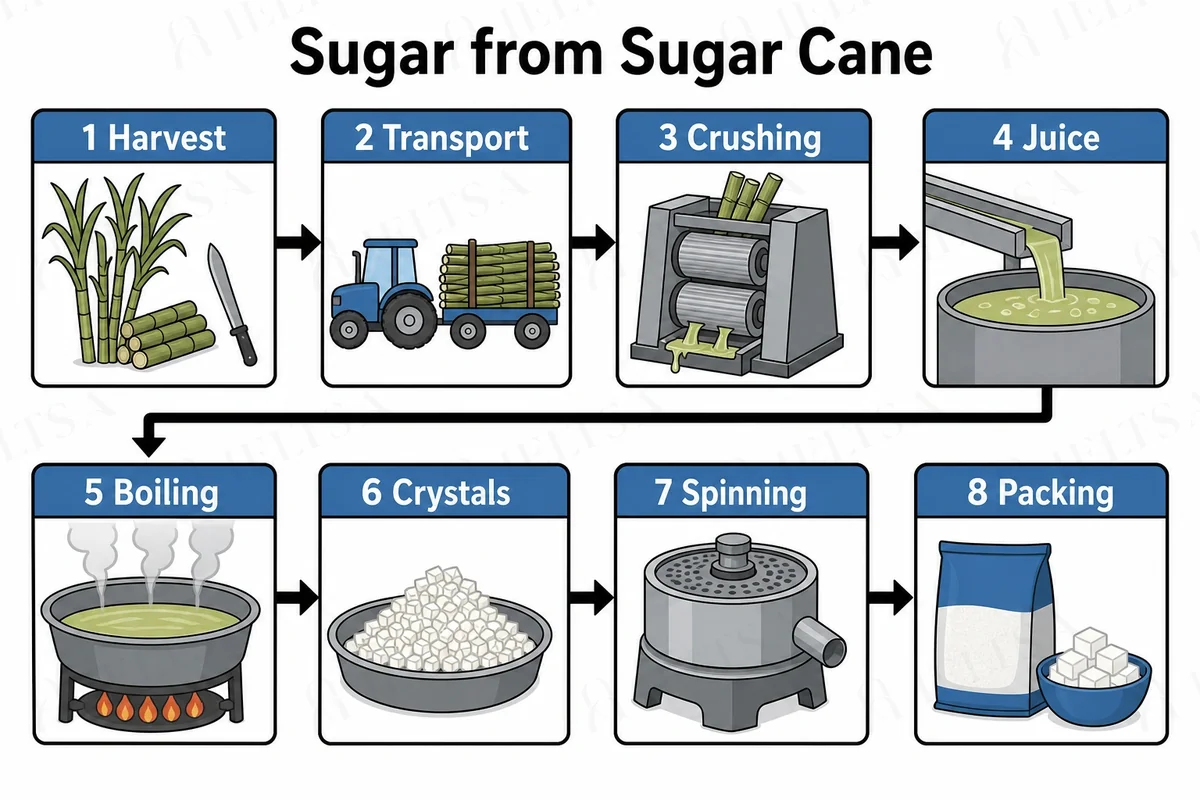
The diagram below shows how sugar is produced from sugar cane.
Summarise the information by selecting and reporting the main features, and make comparisons where relevant.
Write at least 150 words.
Instructions
You should spend about 20 minutes on this task.
• Begin with an overview: say how many stages there are and where the process starts and ends.
• Describe the stages in order, using sequence words such as first, then, after that and finally.
• Use the passive voice where suitable and do not give your own opinions.
• State the first and last stages in your overview.
How to approach this process diagram question
A process diagram shows how something is made or how a cycle works. Describe the stages in order, using sequence language and the passive voice.
- Say what process the diagram shows and how many stages it has.
- Overview: the number of stages, where it starts and ends, and whether it is a cycle or a straight line.
- Describe every stage in order (First, Next, After that, Finally) mostly in the passive: the grain is crushed.
- Do not add opinions or explain why; describe what happens.
How to plan this answer
Structure
- Overview: note that sugar is produced in eight stages, starting with harvest and ending with packing, over two rows.
- Paragraph 2: cover the first four stages (harvest, transport, crushing and juice extraction) using passive verbs.
- Paragraph 3: cover the remaining four stages (boiling, crystal formation, spinning and packing) and the transition from the first row to the second.
- Optionally add a sentence noting that the juice is the key intermediate product before boiling.
Key features to spot
- Stage 1 is harvest, shown as bundles of tall cane stalks cut with a long knife, so the process begins in the field.
- Stage 2 is transport, where a tractor pulls a trailer loaded with cut cane to the processing site.
- Stage 3 is crushing, where the cane passes between heavy rollers that squeeze out a green liquid.
- Stage 4 is juice, collected in a large open vat, and stage 5 is boiling, where the juice is heated over a fire until it thickens.
- Stage 6 is crystals, a tray of white sugar cubes, and stage 7 is spinning in a perforated drum that separates the sugar from the liquid.
- Stage 8 is packing, where the sugar is placed into a bag, with a small bowl of sugar cubes shown beside it.
Useful vocabulary
- is harvested: The sugar cane is harvested by hand before it is transported.
- is transported to: The cut cane is transported to the processing plant on a trailer.
- is crushed between: The stalks are crushed between heavy rollers.
- is extracted from: The juice is extracted from the cane during the crushing stage.
- is boiled until: The juice is boiled until it thickens into a syrup.
- form: Crystals form as the syrup cools and hardens in the tray.
- is spun in: The crystals are spun in a drum to separate the sugar from the liquid.
- is packed into: The refined sugar is packed into bags for sale.
- is followed by: Harvesting is followed by transport to the mill.
- once ... has been: Once the juice has been boiled, the crystals begin to form.
Common mistakes
- Writing that the cane is 'grown' in the diagram; the picture starts at the harvest stage, so growing is outside the scope of the process shown.
- Confusing the crystals stage with the packing stage, or describing the sugar cubes in the bowl as a separate product rather than an example of the packed sugar.
- Describing the spinning drum as a mixing machine, when it is shown separating the sugar crystals from the syrup.
- Misplacing the juice stage as the first stage in the row, rather than the fourth stage in the process.
- Using the active voice where the diagram is about what is done to the cane (for example, the mill crushes the cane).
Examiner tip: Keep the eight stages in order and use the passive for each action; a brief reference to the two rows helps the reader follow the transition from juice to boiling.
Write your answer
Sign in with Google to write online and get 8 free answers marked each month against the IELTS band criteria. No card, no password.
Sign in with Google to writeMore practice questions
Practise all four IELTS skills
Listening, Reading, Writing and Speaking with band 8 samples at ieltsa.org.