Wastewater Treatment
The question
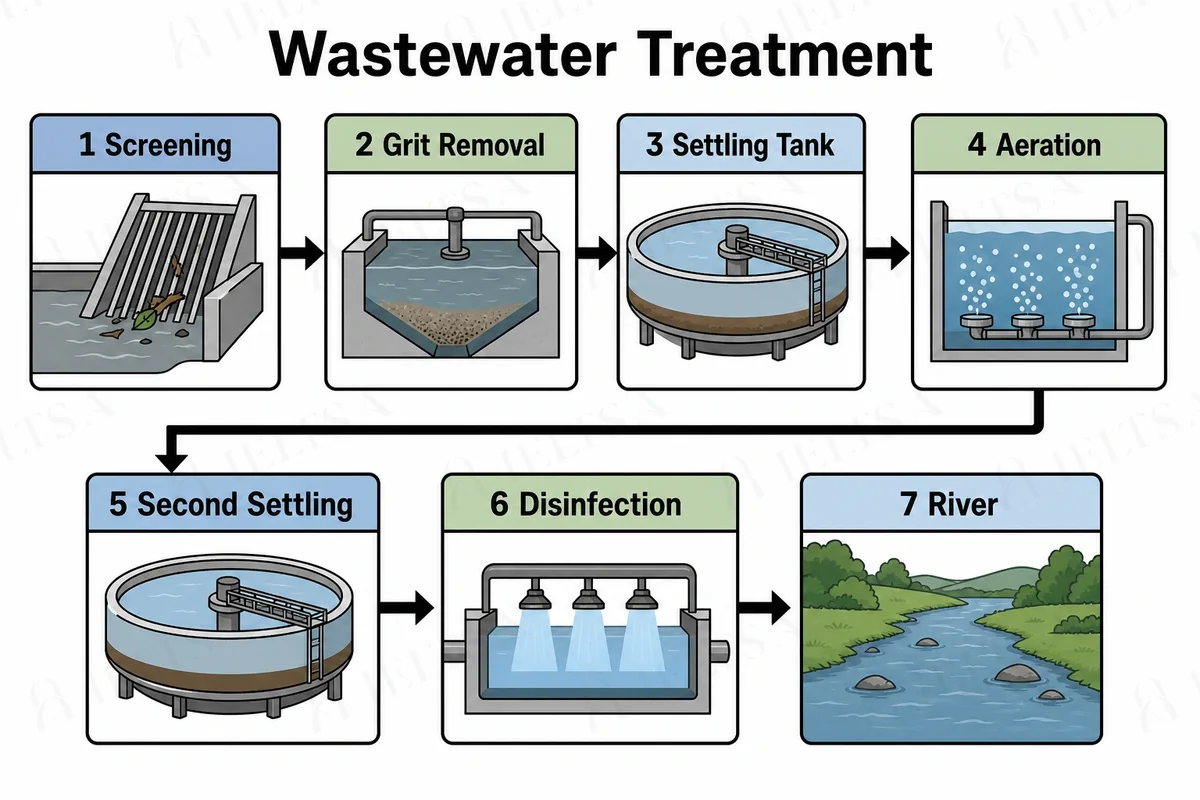
The diagram below shows how wastewater is treated before it returns to a river.
Summarise the information by selecting and reporting the main features, and make comparisons where relevant.
Write at least 150 words.
Instructions
You should spend about 20 minutes on this task.
• Begin with an overview: say how many stages there are and where the process starts and ends.
• Describe the stages in order, using sequence words such as first, then, after that and finally.
• Use the passive voice where suitable and do not give your own opinions.
• State the first and last stages in your overview.
How to approach this process diagram question
A process diagram shows how something is made or how a cycle works. Describe the stages in order, using sequence language and the passive voice.
- Say what process the diagram shows and how many stages it has.
- Overview: the number of stages, where it starts and ends, and whether it is a cycle or a straight line.
- Describe every stage in order (First, Next, After that, Finally) mostly in the passive: the grain is crushed.
- Do not add opinions or explain why; describe what happens.
How to plan this answer
Structure
- Overview: state that wastewater is treated in seven stages, starting with screening and ending in the river, across two rows.
- Paragraph 2: describe the first four stages (screening, grit removal, settling and aeration), noting what is removed at each point.
- Paragraph 3: describe the last three stages (second settling, disinfection and discharge to the river).
- End with a sentence that makes clear the treated water is returned to the river at the end of the process.
Key features to spot
- Stage 1 is screening, where a set of inclined metal bars catches leaves, sticks and other large objects before the water moves on.
- Stage 2 is grit removal in a shallow channel, where sand and gravel settle to the bottom and are collected.
- Stage 3 is a circular settling tank with a rotating scraper, where solid matter sinks and is removed.
- Stage 4 is aeration, where air bubbles are released from diffusers in a rectangular tank to support the breakdown of waste.
- Stage 5 is a second circular settling tank, which removes the remaining solids before disinfection.
- Stage 6 is disinfection, shown as three spray heads that spray the water, and stage 7 is the river, which receives the treated water.
Useful vocabulary
- is screened to: The wastewater is screened to remove large solid objects.
- is allowed to settle: The water is allowed to settle in a circular tank so that solids sink.
- are removed from: Grit and sand are removed from the channel by a scraper.
- is aerated in: The water is aerated in a tank before the second settling stage.
- is treated with: The water is treated with disinfectant before it is released.
- is discharged into: The treated water is discharged into the river.
- is then passed to: After screening, the water is then passed to the grit channel.
- the final stage: The final stage is the release of treated water into the river.
- before it is returned to: The water is treated before it is returned to the river.
- is followed by: Aeration is followed by a second settling stage.
Common mistakes
- Describing both settling tanks as identical stages, when the task requires them to be listed separately as stages 3 and 5.
- Calling the aeration tank a 'mixing tank' rather than naming the bubbles that come from the diffusers.
- Stating that the river is a treatment stage; it is the final destination, and the overview should say so.
- Missing the second row and therefore failing to show that the process continues from stage 4 down to stage 5.
- Explaining the chemistry of disinfection in detail, which goes beyond what the diagram shows and wastes words.
Examiner tip: Name the first and last stages in the overview and describe each tank by its shape and function so that the two settling stages are clearly distinguished.
Write your answer
Sign in with Google to write online and get 8 free answers marked each month against the IELTS band criteria. No card, no password.
Sign in with Google to writeMore practice questions
Practise all four IELTS skills
Listening, Reading, Writing and Speaking with band 8 samples at ieltsa.org.