Hydroelectric Power Generation
The question
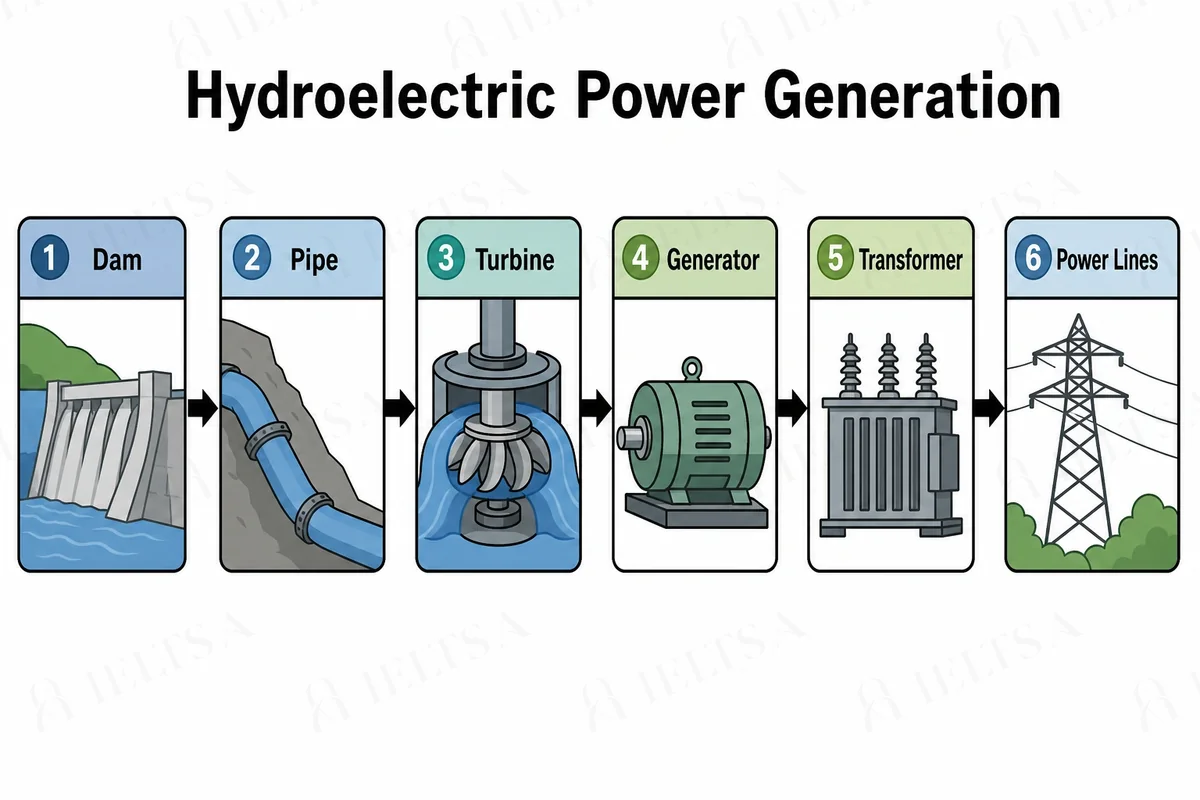
The diagram below shows how electricity is generated in a hydroelectric power station.
Summarise the information by selecting and reporting the main features, and make comparisons where relevant.
Write at least 150 words.
Instructions
You should spend about 20 minutes on this task.
• Begin with an overview: say how many stages there are and where the process starts and ends.
• Describe the stages in order, using sequence words such as first, then, after that and finally.
• Use the passive voice where suitable and do not give your own opinions.
• State the first and last stages in your overview.
How to approach this process diagram question
A process diagram shows how something is made or how a cycle works. Describe the stages in order, using sequence language and the passive voice.
- Say what process the diagram shows and how many stages it has.
- Overview: the number of stages, where it starts and ends, and whether it is a cycle or a straight line.
- Describe every stage in order (First, Next, After that, Finally) mostly in the passive: the grain is crushed.
- Do not add opinions or explain why; describe what happens.
How to plan this answer
Structure
- Overview: the diagram shows six stages in one row, from the dam to the power lines, as a linear process with no return.
- Body 1: stages 1 to 3, where water is held back by the dam, flows through a pipe and turns the turbine.
- Body 2: stages 4 to 6, where the generator, transformer and power lines carry the electricity to users.
Key features to spot
- The dam holds back a large body of water, which is shown on the left of the diagram.
- The water flows through a large pipe down the hillside towards the power station.
- The force of the water turns the blades of the turbine.
- The generator converts the turning motion into electricity.
- The transformer changes the electricity, and power lines carry it to homes and businesses.
Useful vocabulary
- is held back by: The water is held back by the dam.
- flows through: The water flows through a large pipe.
- turns: The water turns the turbine.
- is converted into: The motion is converted into electricity.
- is transformed: The electricity is transformed before it is sent along the lines.
- is carried by: The electricity is carried by power lines.
- is followed by: The turbine is followed by the generator.
- the first stage: The first stage is the dam.
- the final stage: The final stage is the power lines.
- from left to right: The six stages are read from left to right.
Common mistakes
- Saying the dam itself generates electricity. The dam holds back water, and the generator produces the electricity.
- Presenting the process as a cycle. It is a one-way process ending with the power lines.
- Reversing the transformer and generator. The generator comes before the transformer.
- Describing the pipe as a tunnel. The diagram shows a pipe running down the slope.
- Using the active voice throughout. Use the passive where suitable, such as the water is directed.
Examiner tip: State in your overview that the process is linear with six stages from the dam to the power lines, then describe the water stages first and the electricity stages second.
Write your answer
Sign in with Google to write online and get 8 free answers marked each month against the IELTS band criteria. No card, no password.
Sign in with Google to writeMore practice questions
Practise all four IELTS skills
Listening, Reading, Writing and Speaking with band 8 samples at ieltsa.org.