How the Water Cycle Works
The question
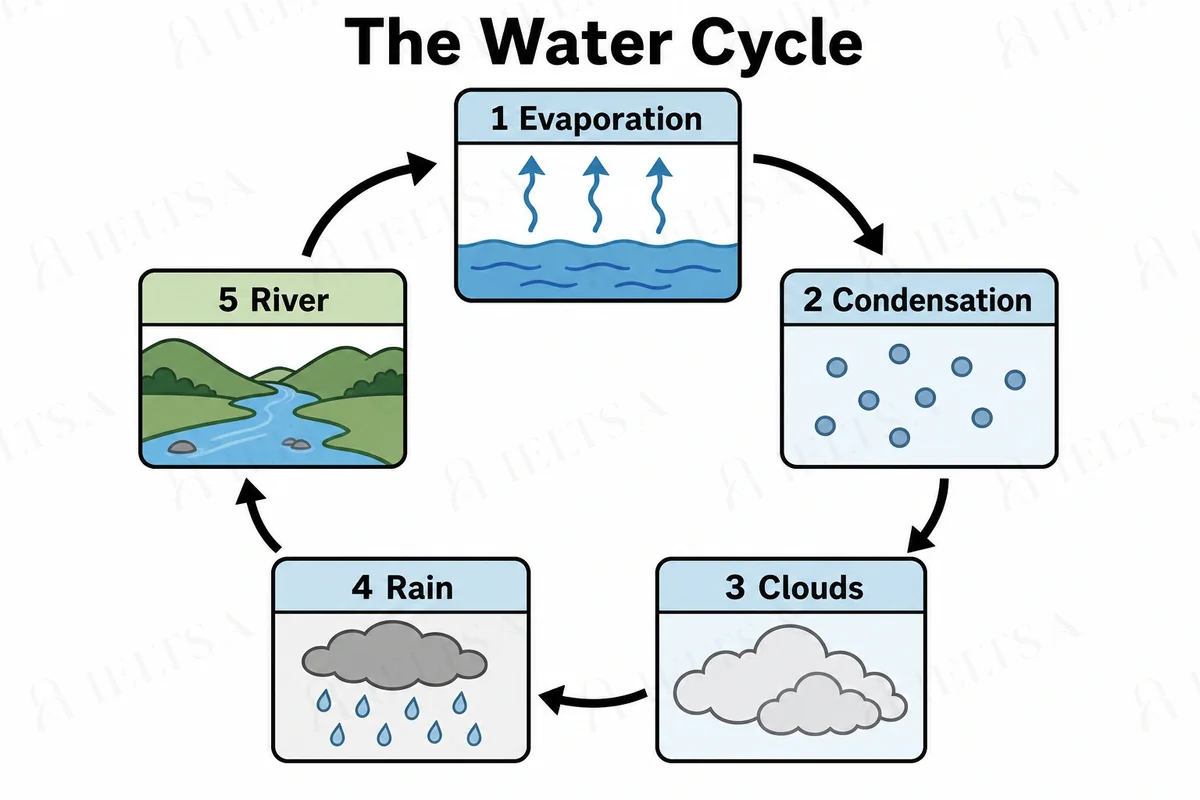
The diagram below shows the stages of the water cycle.
Summarise the information by selecting and reporting the main features, and make comparisons where relevant.
Write at least 150 words.
Instructions
You should spend about 20 minutes on this task.
• Begin with an overview: say how many stages there are and where the process starts and ends.
• Describe the stages in order, using sequence words such as first, then, after that and finally.
• Use the passive voice where suitable and do not give your own opinions.
• Explain how the cycle repeats rather than treating it as a line.
How to approach this process diagram question
A process diagram shows how something is made or how a cycle works. Describe the stages in order, using sequence language and the passive voice.
- Say what process the diagram shows and how many stages it has.
- Overview: the number of stages, where it starts and ends, and whether it is a cycle or a straight line.
- Describe every stage in order (First, Next, After that, Finally) mostly in the passive: the grain is crushed.
- Do not add opinions or explain why; describe what happens.
How to plan this answer
Structure
- Overview: the diagram shows five stages in a circle, with no true start or end, and the cycle repeats continuously.
- Body 1: stage 1 (evaporation, water rising from the sea) followed by stage 2 (condensation) and stage 3 (clouds).
- Body 2: stage 4 (rain) and stage 5 (river), and the arrow from the river back to evaporation to show the repetition.
Key features to spot
- Evaporation is shown as water rising from the sea in the form of arrows above the water surface.
- Condensation forms small droplets, and the clouds are the next stage in the circle.
- Rain falls from the clouds, and the water then flows into the river.
- The arrow from the river back to evaporation shows that the process is a continuous loop.
- Because the cycle has no starting point, the overview should explain where the commonly described start is.
Useful vocabulary
- water vapour rises: Water vapour rises from the sea during evaporation.
- is condensed into: The vapour is condensed into tiny droplets.
- form clouds: The droplets form clouds in the sky.
- falls as rain: Water falls as rain from the clouds.
- flows into: The rainwater flows into the river.
- the cycle is repeated: The cycle is repeated continuously.
- is followed by: Evaporation is followed by condensation.
- returns to: Water from the river returns to evaporation.
- is shown as a circle: The process is shown as a circle of five stages.
- the first stage: The first stage is evaporation.
Common mistakes
- Presenting the water cycle as a straight line with a final stage. The arrow from the river to evaporation makes it a loop.
- Saying the cycle begins at the river. The usual starting point is evaporation, with the river leading back to it.
- Putting rain before clouds. Clouds form first, and rain falls from them.
- Using only active verbs. Use passive forms such as is evaporated and is condensed where suitable.
- Adding causes such as climate change. The task does not allow speculation.
Examiner tip: Make the circular nature clear in your overview, then use sequence words such as first, then and finally to walk through the five stages in order.
Model answers by band score
Written for this question to show what changes from one band to the next. Try the task yourself first, then compare.
Band 6 answer
The diagram show the water cycle, which has five stages. The process start with evaporation and it ends with the river, then it go back to the beginning again.
First, the water from the sea is evaporated and it goes up in the air. Next, the condensation happen. In this stage the water in the air becomes small drops of water.
After that, the small drops make clouds. This is the third stage of the cycle. Then the clouds make rain, and the rain falls down to the ground. This is the fourth stage.
Finally, the rain goes to the river. The river is the fifth stage. After that, the water in the river go back to the evaporation stage and the cycle begins again, so it is a circle and it never stop.
In conclusion, there are five stages in the water cycle, and the water move around from the sea to the air and then to the river.
Why this is band 6
- The overview states the number of stages (five) and where the cycle starts and ends, as the task instruction requires.
- All five stages are described in the correct order with basic sequence words (First, Next, After that, Then, Finally).
- Repeated structures and agreement errors ('The diagram show', 'it go back', 'it never stop') limit grammar and show a narrow range.
- The passive is attempted only once ('is evaporated'). Band 7 would use it consistently and explain how the stages are linked.
Band 7 answer
The diagram illustrates the water cycle, which consists of five stages. The process begins with evaporation from the sea and finishes with a river, from which the water returns to the start, so the cycle is continuous.
In the first stage, water is evaporated from the surface of the sea and rises into the air. During the second stage, condensation, the rising water vapour cools and forms tiny droplets in the air.
These droplets then gather together to form clouds, which is the third stage of the process. Next, the clouds release the water as rain in the fourth stage, and the rain falls to the ground.
In the final stage, the rainwater collects in a river. This river is shown with an arrow leading back to the evaporation stage, which means that the water is carried back towards the sea, where it evaporates again and the whole cycle is repeated.
Why this is band 7
- Overview gives the number of stages and shows that the process is a cycle, with the start and finish identified.
- Well organised: each stage is a clear step, and sequencing is signalled with 'In the first stage', 'then', 'Next' and 'In the final stage'.
- Passive voice is used appropriately ('is evaporated', 'is repeated') and the answer explains the repetition rather than treating it as a line.
- A band 8 report would vary its sequencing and use more precise process vocabulary, with less repetition of 'stage'.
Band 8 answer
The diagram shows the water cycle, a continuous process made up of five stages. It starts with evaporation from the sea and ends with a river, from which the water flows back into the first stage, so the sequence repeats indefinitely.
Initially, water at the surface of the sea is evaporated and rises into the air as vapour. As it rises, it undergoes condensation, the second stage, in which it cools and turns into countless tiny droplets.
Subsequently, these droplets accumulate to form clouds, the third stage. The water is then released from the clouds in the form of rain, which marks the fourth stage and returns the water to the ground.
Finally, the rainwater is collected by a river. According to the diagram, an arrow leads from the river back to evaporation, which indicates that the water is carried onwards and eventually evaporates again. In this way, the same water is recycled continually rather than used up.
Why this is band 8
- Overview captures stages, start, end and the cyclical nature in one coherent statement.
- Precise process vocabulary ('accumulate', 'undergoes condensation', 'recycled') and well-controlled passives.
- Natural cohesion ('Initially', 'As it rises', 'Subsequently', 'Finally') and clear explanation of how the cycle closes.
- Band 9 would be even more economical, and would express the closing of the loop without the slightly formulaic 'In this way'.
Band 9 answer
The diagram depicts the water cycle, a closed process comprising five numbered stages. It begins with evaporation from the sea and ends at a river, from which the water re-enters the first stage, so the sequence repeats continuously.
Water at the surface of the sea is first evaporated and ascends into the air. This vapour then undergoes condensation, the second stage, in which it forms myriad minute droplets.
These droplets subsequently gather into clouds, the third stage, from which the water is released as rain in the fourth. The rain falls back to the ground, and in the fifth and final stage it is gathered by a river.
The arrow leading from the river to the evaporation stage shows that the cycle does not terminate there: the river water is carried onwards and is evaporated once more. The process is therefore best understood as a loop in which the same water is endlessly cycled between sea, air and land.
Why this is band 9
- Overview is complete and elegant: stage count, start, end and the loop in a single flowing statement.
- Fully natural passive constructions and precise process lexis ('ascends', 'myriad minute droplets', 'terminate').
- Every stage appears in correct order with seamless cohesion and no sign of mechanical sequencing.
- Interpretation stays faithful to the diagram (the arrow back to evaporation), and the text is essentially error-free.
Band levels are our estimate against the public IELTS criteria; they are not official scores.
Write your answer
Sign in with Google to write online and get 8 free answers marked each month against the IELTS band criteria. No card, no password.
Sign in with Google to writeMore practice questions
Practise all four IELTS skills
Listening, Reading, Writing and Speaking with band 8 samples at ieltsa.org.