Cement Production
The question
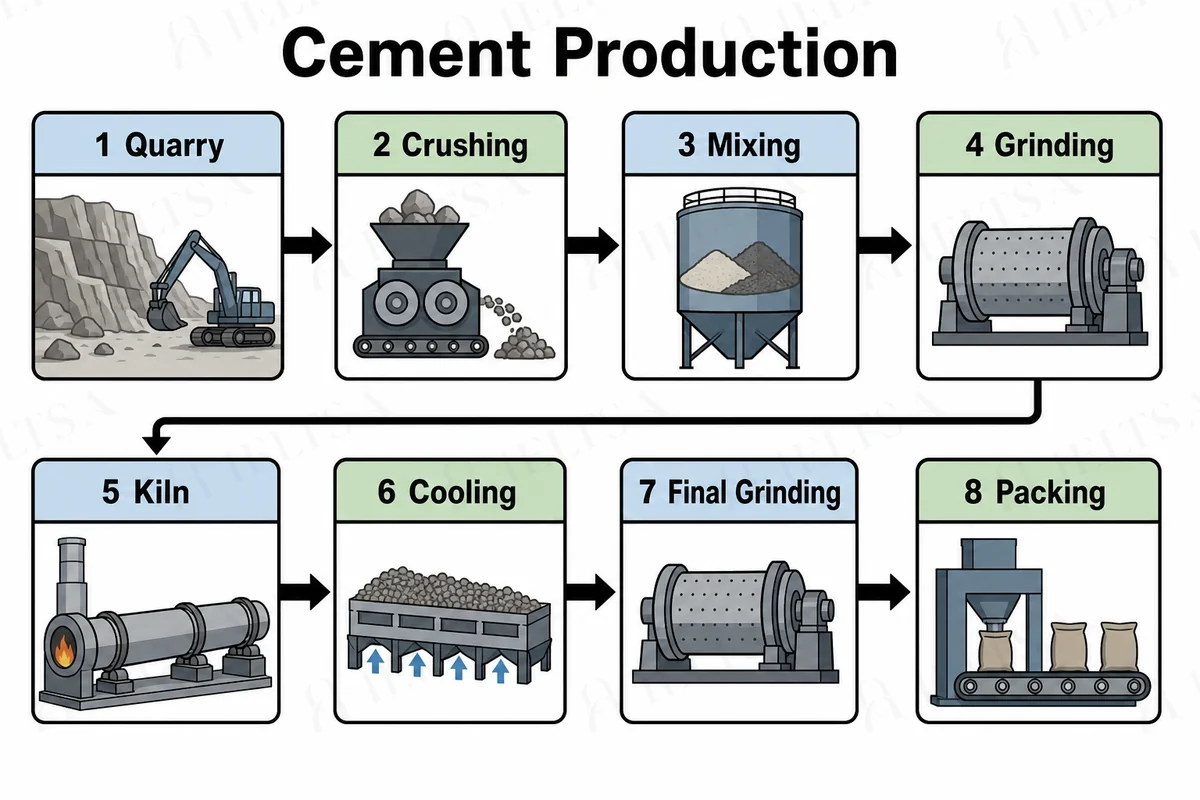
The diagram below shows how cement is produced.
Summarise the information by selecting and reporting the main features, and make comparisons where relevant.
Write at least 150 words.
Instructions
You should spend about 20 minutes on this task.
• Begin with an overview: say how many stages there are and where the process starts and ends.
• Describe the stages in order, using sequence words such as first, then, after that and finally.
• Use the passive voice where suitable and do not give your own opinions.
• State the first and last stages in your overview.
How to approach this process diagram question
A process diagram shows how something is made or how a cycle works. Describe the stages in order, using sequence language and the passive voice.
- Say what process the diagram shows and how many stages it has.
- Overview: the number of stages, where it starts and ends, and whether it is a cycle or a straight line.
- Describe every stage in order (First, Next, After that, Finally) mostly in the passive: the grain is crushed.
- Do not add opinions or explain why; describe what happens.
How to plan this answer
Structure
- Overview: state that cement is produced in eight stages, starting with quarrying and ending with packing, and note the two-row layout.
- Paragraph 2: describe the first four stages in order (quarrying, crushing, mixing and grinding), with the excavator and the crusher as the physical actions.
- Paragraph 3: describe the remaining four stages (kiln, cooling, final grinding and packing), including the move from the top row to the bottom row.
- Do not add an opinion or a conclusion paragraph; a closing sentence restating the start and end is enough.
Key features to spot
- Stage 1 is a quarry, where an excavator digs raw material from a rock face, so the process begins with extraction rather than manufacturing.
- Stage 2 uses a crusher with two large rollers to break the rock into smaller pieces, which are then dropped onto a conveyor or pile.
- Stage 3 is mixing, shown as a tall silo that holds two different powdered materials, which are combined inside it.
- Stage 4 is grinding in a rotating drum mill, and stage 5 is a long, inclined kiln heated by a fire at one end.
- Stage 6 is cooling on a bed with upward airflow, and stage 7 is a second, smaller grinding drum that produces the final powder.
- The process ends with stage 8, where the cement is poured into a hopper and filled into sacks on a conveyor belt.
Useful vocabulary
- is extracted from: The raw rock is extracted from a quarry before it is crushed.
- is fed into: The crushed material is fed into a mixing silo.
- is subsequently ground: The mixture is subsequently ground in a rotating drum.
- is heated in: The powder is heated in a long rotating kiln.
- is left to cool: After heating, the material is left to cool on a bed of grates.
- is then ground again: The cooled material is then ground again to a fine powder.
- is filled into sacks: The finished cement is filled into sacks at the packing stage.
- is followed by: Crushing is followed by mixing, which takes place in a silo.
- once ... has been: Once the rock has been crushed, it is moved to the mixing silo.
- the final stage involves: The final stage involves filling and sealing the bags for transport.
Common mistakes
- Describing the process as starting at the mixing silo because it is the first large object seen in the top row; the diagram starts at the quarry.
- Confusing the two grinding stages and describing only one of them, so the final grinding step is missing from the account.
- Treating the two rows as separate processes instead of one sequence that continues from stage 4 down to stage 5.
- Using the active voice throughout (for example, the workers crush the rock), when the task asks for passive forms where suitable.
- Adding a view on the environmental impact of cement production, which the task explicitly forbids.
Examiner tip: Name the first and last stages in your overview and check that the eight stages appear in the same order as the numbers in the diagram.
Write your answer
Sign in with Google to write online and get 8 free answers marked each month against the IELTS band criteria. No card, no password.
Sign in with Google to writeMore practice questions
Practise all four IELTS skills
Listening, Reading, Writing and Speaking with band 8 samples at ieltsa.org.