The Carbon Cycle
The question
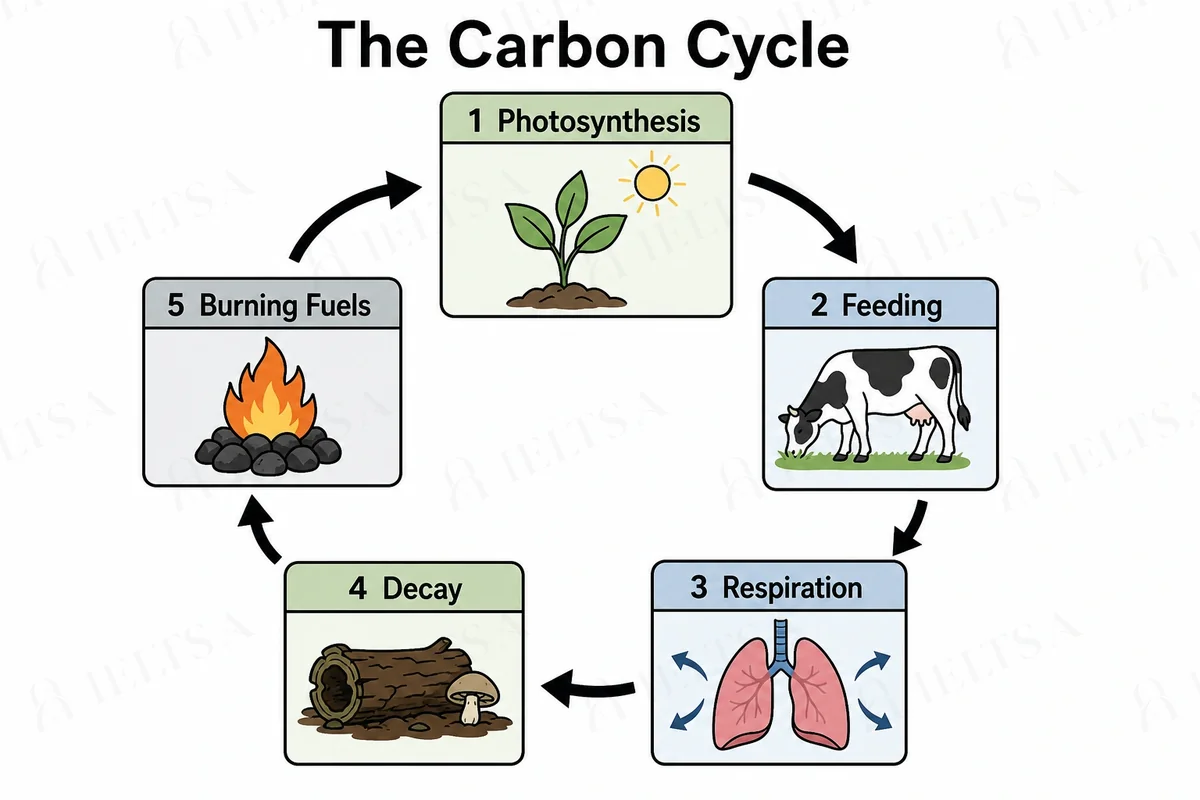
The diagram below shows a simplified carbon cycle.
Summarise the information by selecting and reporting the main features, and make comparisons where relevant.
Write at least 150 words.
Instructions
You should spend about 20 minutes on this task.
• Begin with an overview: say how many stages there are and where the process starts and ends.
• Describe the stages in order, using sequence words such as first, then, after that and finally.
• Use the passive voice where suitable and do not give your own opinions.
• Explain how the cycle repeats rather than treating it as a line.
How to approach this process diagram question
A process diagram shows how something is made or how a cycle works. Describe the stages in order, using sequence language and the passive voice.
- Say what process the diagram shows and how many stages it has.
- Overview: the number of stages, where it starts and ends, and whether it is a cycle or a straight line.
- Describe every stage in order (First, Next, After that, Finally) mostly in the passive: the grain is crushed.
- Do not add opinions or explain why; describe what happens.
How to plan this answer
Structure
- Overview: state that the carbon cycle has five stages arranged in a circle, with no clear start or end point, and that burning fuels links back to photosynthesis.
- Paragraph 2: describe the stages in the order of the arrows, starting from photosynthesis and moving clockwise through feeding, respiration and decay.
- Paragraph 3: explain the final part of the loop, where burning fuels returns carbon to the atmosphere and the cycle repeats.
- Keep the explanation of the loop as a cycle and avoid calling any stage the last one.
Key features to spot
- Stage 1 is photosynthesis, shown as a young green plant with the sun above it, where plants take in carbon dioxide and produce sugars.
- Stage 2 is feeding, shown as a grazing cow, which passes carbon from plants into animals through their diet.
- Stage 3 is respiration, shown as a pair of lungs with arrows leaving them, which returns carbon dioxide to the air.
- Stage 4 is decay, shown as a rotting log with a mushroom, where dead material breaks down and releases carbon into the soil.
- Stage 5 is burning fuels, shown as a fire on a heap of coal, which releases carbon into the atmosphere and connects back to photosynthesis.
- The arrow from burning fuels to photosynthesis shows that the cycle repeats, so the process does not have a beginning or an end.
Useful vocabulary
- forms a cycle: The five stages form a cycle, with carbon passing from one stage to the next.
- is absorbed by: Carbon dioxide is absorbed by plants during photosynthesis.
- is passed on to: Carbon is passed on to animals when they feed on plants.
- is released into: Carbon dioxide is released into the air during respiration.
- is returned to: Carbon is returned to the soil through decay.
- is emitted when: Carbon is emitted when fuels are burned.
- leads back to: Burning fuels leads back to photosynthesis, which completes the loop.
- repeats: The cycle repeats continuously, so carbon moves between living things and the air.
- in a clockwise direction: The stages are arranged in a clockwise direction around the circle.
- passes from ... to: Carbon passes from the plant to the animal when the cow eats grass.
Common mistakes
- Describing the process as having a start and an end, when the arrows form a closed circle with no first or last stage.
- Stating that burning fuels is the final stage of the cycle; it is the fifth stage, and its arrow leads back to the first.
- Describing photosynthesis as the cow's activity, or assigning feeding to the plant, which mixes up the roles of the two pictures.
- Omitting the explanation of why the cycle repeats, which is the specific feature the task asks candidates to show.
- Adding scientific detail such as chemical equations, which goes beyond the diagram and is not required for this task.
Examiner tip: Explain that the arrows form a loop and that burning fuels links back to photosynthesis, so the answer shows the cycle rather than a straight line.
Write your answer
Sign in with Google to write online and get 8 free answers marked each month against the IELTS band criteria. No card, no password.
Sign in with Google to writeMore practice questions
Practise all four IELTS skills
Listening, Reading, Writing and Speaking with band 8 samples at ieltsa.org.