Science Research Funding Trends
The question
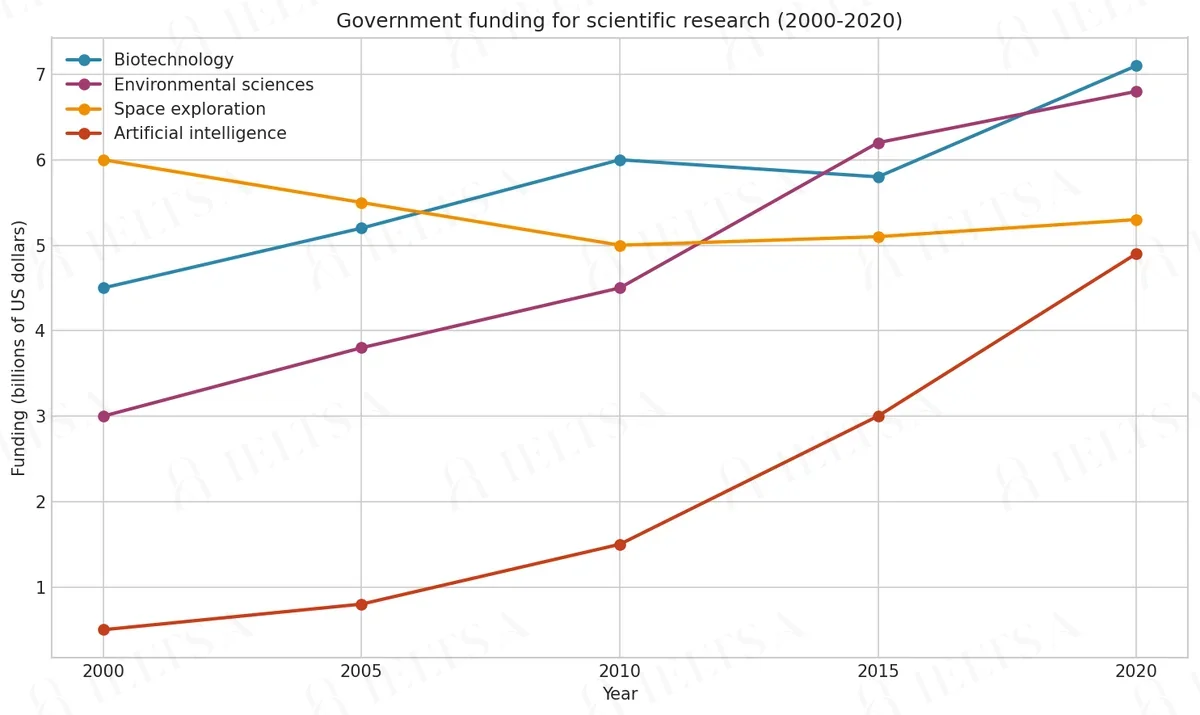
The line graph below shows government funding for scientific research in four different fields in a developed country between 2000 and 2020.
Summarise the information by selecting and reporting the main features, and make comparisons where relevant.
Write at least 150 words.
Instructions
You should spend about 20 minutes on this task.
• Begin with an overview of the main trends or differences
• Compare the four fields and highlight the fastest-growing one
• Use appropriate vocabulary for describing data
• Include figures and units to support your points
How to approach this line graph question
A line graph shows change over time. Your job is to describe the trends and compare the lines, not to list every point.
- Paraphrase the question, giving the time span and units.
- Overview: the overall direction of each line and where they cross or finish.
- Describe each trend with a range of verbs (rose steadily, fell sharply, levelled off) and time markers.
- Mention the highest points, lowest points and any crossover.
How to plan this answer
Structure
- Overview: one sentence stating that three of the four fields received more funding by 2020, with artificial intelligence growing fastest, while space exploration was the only field to fall overall.
- Body 1: artificial intelligence, the fastest-growing field, from 0.5 to 4.9 billion US dollars.
- Body 2: biotechnology and environmental sciences, which both rose, and the overtaking points between them and space exploration.
- Body 3: space exploration, which started highest, dipped to 5.0 in 2010 and ended at 5.3.
Key features to spot
- Artificial intelligence rose from 0.5 billion US dollars in 2000 to 4.9 billion in 2020, nearly tenfold, the fastest growth on the chart.
- Artificial intelligence was the lowest-funded field in every year shown, but it rose most sharply after 2010, adding 1.5 billion between 2010 and 2015 and 1.9 billion between 2015 and 2020.
- Biotechnology was the highest-funded field in 2020 at 7.1 billion, after a small dip from 6.0 in 2010 to 5.8 in 2015.
- Environmental sciences rose from 3.0 to 6.8 billion and overtook space exploration by 2015, when it stood at 6.2 billion against 5.1 billion.
- Space exploration started as the highest-funded field at 6.0 billion in 2000, fell to 5.0 in 2010 and recovered slightly to 5.3 by 2020.
Useful vocabulary
- to rise steadily: Funding for biotechnology rose steadily until 2010.
- to overtake: Environmental sciences overtook space exploration by 2015.
- to dip: Biotechnology dipped slightly to 5.8 billion in 2015.
- a sharp increase: Artificial intelligence saw a sharp increase after 2010.
- to peak: Biotechnology peaked at 7.1 billion in 2020.
- to remain the lowest: Artificial intelligence remained the lowest-funded field throughout.
- to fluctuate between: Space exploration fluctuated between 5.0 and 6.0 billion.
- nearly tenfold: Funding for artificial intelligence grew nearly tenfold over two decades.
- to gain ground: Artificial intelligence gained considerable ground on the other fields.
- billion US dollars: Funding for biotechnology reached 7.1 billion US dollars.
Common mistakes
- Writing '4.9 million' instead of '4.9 billion' when quoting the funding figures.
- Calling artificial intelligence the most-funded field, when it was the lowest-funded in every year.
- Describing space exploration as falling steadily, when it dipped and then recovered slightly.
- Missing the overtaking point between environmental sciences and space exploration.
- Giving the values for all four fields and all five years in a list, instead of summarising the main features.
Examiner tip: Name the fastest-growing field with its start and end values, then show the overtaking points, since comparisons across years are the central feature of this line graph.
Write your answer
Sign in with Google to write online and get 8 free answers marked each month against the IELTS band criteria. No card, no password.
Sign in with Google to writeMore practice questions
Practise all four IELTS skills
Listening, Reading, Writing and Speaking with band 8 samples at ieltsa.org.