UK Internet Usage by Age Group 2010-2020
The question
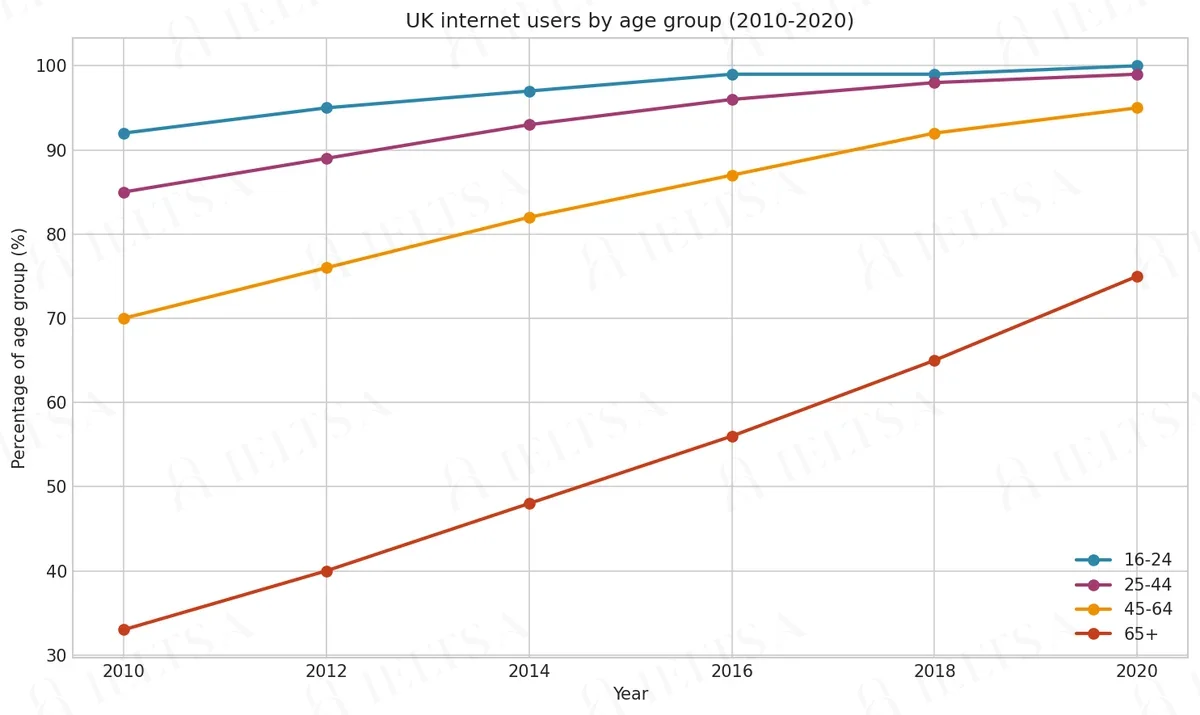
The chart below shows the percentage of UK citizens using the internet by age group from 2010 to 2020.
Summarise the information by selecting and reporting the main features, and make comparisons where relevant.
Write at least 150 words.
Instructions
You should spend about 20 minutes on this task.
• Begin with an overview of the main trends or differences
• Compare the age groups and describe the gap between the youngest and oldest
• Use appropriate vocabulary for describing data
• Include figures and units to support your points
How to approach this line graph question
A line graph shows change over time. Your job is to describe the trends and compare the lines, not to list every point.
- Paraphrase the question, giving the time span and units.
- Overview: the overall direction of each line and where they cross or finish.
- Describe each trend with a range of verbs (rose steadily, fell sharply, levelled off) and time markers.
- Mention the highest points, lowest points and any crossover.
How to plan this answer
Structure
- Overview: one sentence stating that internet use rose for all four age groups between 2010 and 2020, and that the 16-24 group was highest throughout.
- Body 1: the two youngest groups (16-24 and 25-44), which both reached very high levels, with the 16-24 group reaching 100 per cent by 2020.
- Body 2: the 45-64 group, which rose from 70 to 95 per cent, and the 65+ group, which rose fastest from the lowest start.
- Body 3: the gap between the youngest and oldest groups, which narrowed from 59 to 25 percentage points over the decade.
Key features to spot
- The 65+ group rose from 33 per cent in 2010 to 75 per cent in 2020, an increase of 42 percentage points, the steepest rise of any group.
- The 16-24 group rose from 92 per cent to 100 per cent, and it was already at 99 per cent in 2016, so growth slowed to a plateau.
- The gap between the 16-24 and 65+ groups was 59 percentage points in 2010 (92 minus 33) and 25 points in 2020 (100 minus 75).
- The 25-44 group rose from 85 to 99 per cent and remained between the youngest group and the 45-64 group in every year shown.
- The 45-64 group rose from 70 to 95 per cent, and the four lines never cross, so the age order was the same in every year.
Useful vocabulary
- the proportion of ... rose from ... to ...: The proportion of over-65s online rose from 33 per cent to 75 per cent.
- to plateau: Internet use among 16-24s plateaued at close to 100 per cent after 2016.
- a steep rise: The over-65s recorded the steepest rise over the decade.
- to narrow the gap: Growth among older users narrowed the gap with the youngest group.
- to remain consistently higher than: The 16-24 group remained consistently higher than every other group.
- a marginal increase: The 25-44 group saw only a marginal increase after 2016.
- reach saturation: Usage in the youngest group had reached near saturation by 2020.
- percentage points: The 65+ group gained 42 percentage points over the decade.
- climb steadily: The 45-64 group climbed steadily throughout the period.
- the most striking feature: The most striking feature is the rapid catch-up by older age groups.
Common mistakes
- Listing every value for every year instead of selecting the main trends and comparisons.
- Describing the 65+ group as having 'caught up' with the youngest group, when the gap narrowed but never closed.
- Writing 'percent' when comparing two changes; use percentage points for differences between percentages.
- Forgetting the overview, and starting directly with figures for each group.
- Failing to name the period (2010 to 2020) or the measure (percentage of each age group using the internet).
Examiner tip: Open with a one-sentence overview of the four trends, then use the gap comparison between the youngest and oldest groups to add precision, quoting years with each figure.
Write your answer
Sign in with Google to write online and get 8 free answers marked each month against the IELTS band criteria. No card, no password.
Sign in with Google to writeMore practice questions
Practise all four IELTS skills
Listening, Reading, Writing and Speaking with band 8 samples at ieltsa.org.