City Zoo Redevelopment Plan
The question
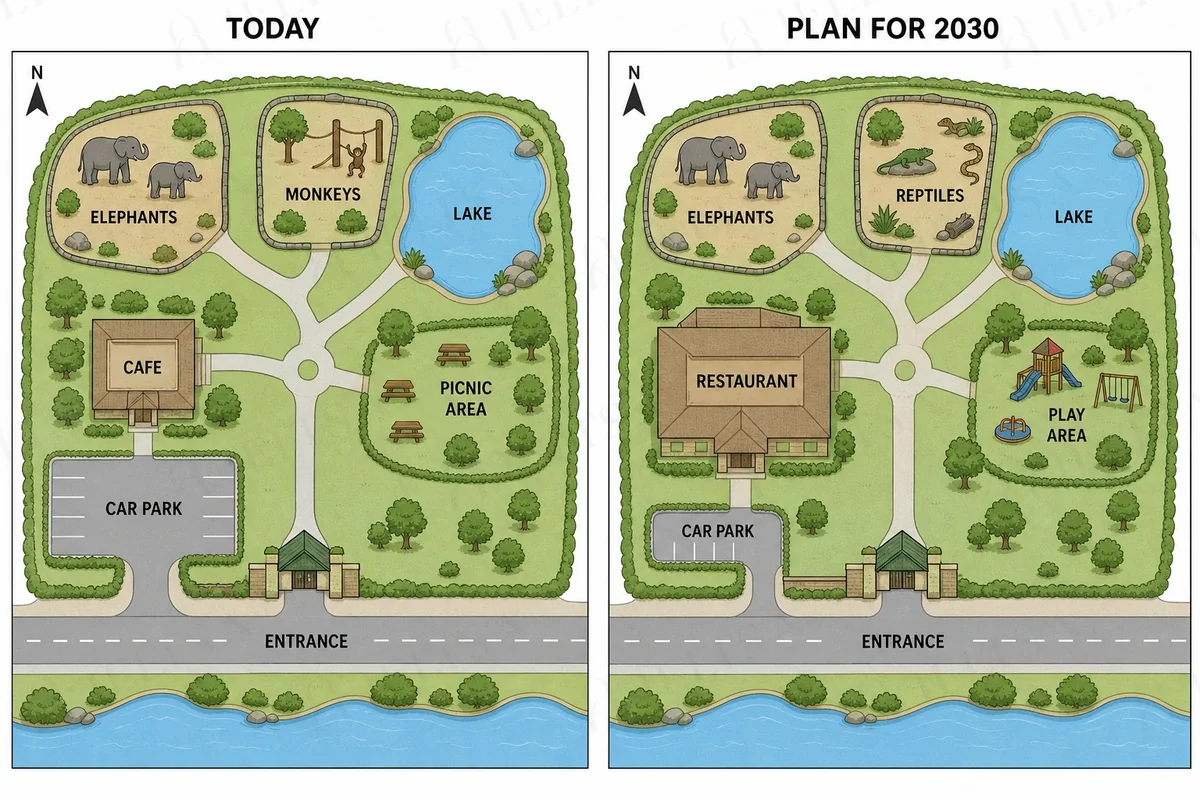
The maps below show a city zoo today and the plan for the zoo in 2030.
Summarise the information by selecting and reporting the main features, and make comparisons where relevant.
Write at least 150 words.
Instructions
You should spend about 20 minutes on this task.
• Begin with an overview of the main planned changes.
• Use future forms and location language such as to the east of and next to.
• Group the changes logically rather than describing every feature in turn.
• Do not give your own opinions.
How to approach this map question
A map question shows a place at two points in time (or two plans). Describe what changed, what stayed the same, and where, using direction and location language.
- Say what the maps show and the two time points in your own words.
- Overview: the main kind of change (for example more building, less green space) and one thing that stays.
- Describe changes area by area (north, south, centre) with verbs such as was replaced by, was converted into, was built.
- Use precise location phrases: to the east of, next to, opposite, in the north-west corner.
How to plan this answer
Structure
- Introduction: paraphrase the maps. The city zoo today and the plan for 2030.
- Overview: the plan will replace several enclosures and visitor facilities and reduce the car park, while the elephants, lake and entrance will remain.
- Body 1: the north and west, where the monkeys area will become reptiles and the cafe will become a larger restaurant.
- Body 2: the east, where the picnic area will become a play area, plus the features that will stay the same.
Key features to spot
- The monkeys area in the north will be replaced by a reptiles area.
- The cafe in the west will be replaced by a larger restaurant.
- The picnic area in the east will be converted into a play area with a slide, swings and a climbing frame.
- The car park in the south-west will be smaller in the plan.
- The elephants area, the lake and the entrance will remain unchanged.
Useful vocabulary
- will be replaced by: The monkeys area will be replaced by a reptiles area.
- will be converted into: The picnic area will be converted into a play area.
- a larger restaurant: The cafe will be replaced by a larger restaurant.
- will be reduced in size: The car park will be reduced in size.
- is planned to: The zoo is planned to add a new play area.
- to the east of: The play area will be to the east of the lake.
- will remain: The elephant enclosure will remain in the same place.
- is due to be: The restaurant is due to be built by 2030.
- the main planned change: The main planned change is the new restaurant.
- next to: The car park will be next to the restaurant.
Common mistakes
- Using the past or present tense for the plan. Use future forms such as will be or is planned to.
- Confusing the monkeys and the elephants. The elephants stay in the west, and the monkeys area becomes reptiles.
- Saying the lake will be removed. The lake remains unchanged.
- Describing the picnic area as removed. It is converted into a play area.
- Adding opinions such as a great improvement. The task asks for a factual description only.
Examiner tip: Use future forms throughout, and describe the planned changes in groups by area, since the plan is best understood as a set of replacements rather than a list.
Write your answer
Sign in with Google to write online and get 8 free answers marked each month against the IELTS band criteria. No card, no password.
Sign in with Google to writeMore practice questions
Practise all four IELTS skills
Listening, Reading, Writing and Speaking with band 8 samples at ieltsa.org.