IELTS Academic Writing Task 1: Crime Statistics Table Analysis
The question
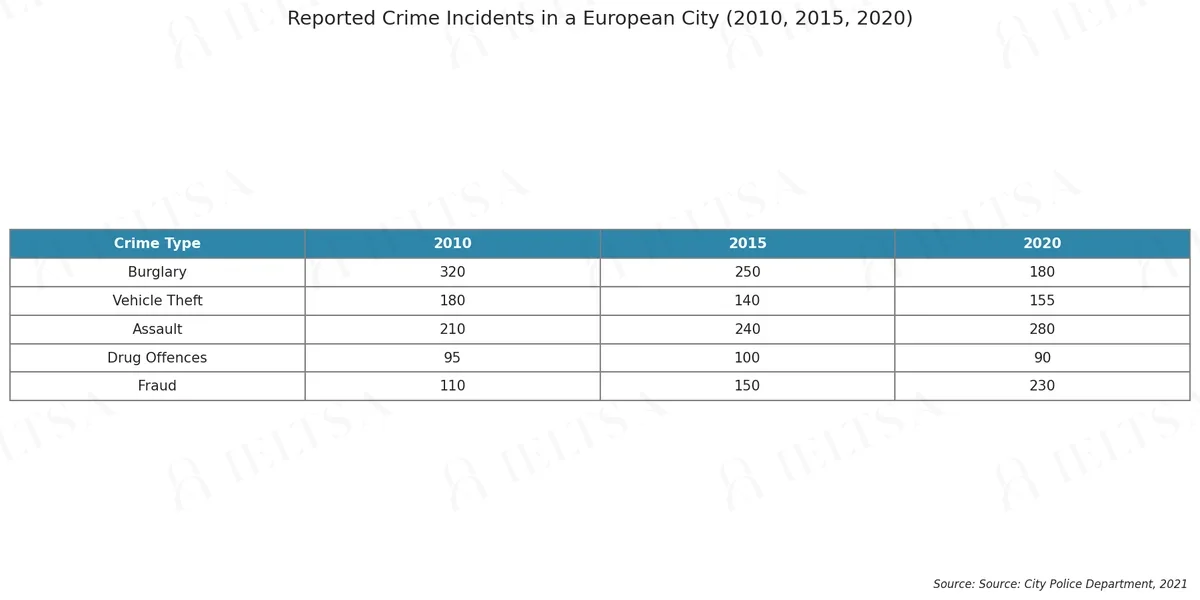
The table below shows the number of reported incidents for five types of crime in a European city over a ten-year period from 2010 to 2020. Summarise the information by selecting and reporting the main features, and make comparisons where relevant.
Instructions
You should spend about 20 minutes on this task. Write at least 150 words.
How to approach this table question
A table packs many numbers into rows and columns. Select the features that matter instead of copying cells.
- Paraphrase the title and say what the rows and columns are.
- Overview: pick two or three clear patterns, such as the highest row and the biggest change.
- Group rows or columns that behave alike.
- Support each point with one or two figures and units.
How to plan this answer
Structure
- Overview: one sentence stating that burglary fell most sharply and assault and fraud rose most, while the overall total changed only slightly.
- Body 1: the falling categories, burglary (320 to 180 thousand) and vehicle theft (180 to 155 thousand), with the dip in vehicle theft in 2015.
- Body 2: the rising categories, assault (210 to 280 thousand) and fraud (110 to 230 thousand), with the rate of growth in each.
- Body 3: the change in ranking, showing that burglary was the largest category in 2010 while assault was the largest in 2020, and that drug offences changed least.
Key features to spot
- Burglary fell from 320 thousand incidents in 2010 to 180 thousand in 2020, a fall of 140 thousand or about 44 per cent.
- Fraud more than doubled, from 110 thousand in 2010 to 230 thousand in 2020, an increase of about 109 per cent.
- Assault rose in each period, from 210 to 240 to 280 thousand, an increase of 70 thousand over the decade.
- Assault overtook burglary between 2015 and 2020 to become the largest category in 2020, with 280 thousand against 180 thousand.
- Vehicle theft fell to 140 thousand in 2015 before rising to 155 thousand in 2020, reversing its earlier trend.
- Drug offences stayed in a narrow range of 90 to 100 thousand, the smallest change of any category.
Useful vocabulary
- a steep decline: Burglary recorded a steep decline over the decade.
- to fall by almost half: Burglary fell by almost half between 2010 and 2020.
- more than doubled: Fraud more than doubled over the ten-year period.
- to climb steadily: Assault climbed steadily in each period shown.
- to reverse: Vehicle theft reversed its downward trend after 2015.
- to overtake: Assault overtook burglary to become the most common offence by 2020.
- to remain relatively stable: Drug offences remained relatively stable across the period.
- to fluctuate: Vehicle theft fluctuated between 140 and 180 thousand.
- a marked increase: Fraud saw a marked increase after 2015.
- the total number of incidents: The total number of incidents was 915 thousand in 2010 and 935 thousand in 2020.
Common mistakes
- Dropping the units, so that '320 thousand' becomes '320 incidents'.
- Quoting a 2015 figure as though it were the 2020 figure, especially for vehicle theft.
- Quoting a percentage that does not match the figures, such as calling the fall in burglary 50 per cent when it is about 44 per cent.
- Claiming that crime rose overall, when the total was 915 thousand in 2010 and 935 thousand in 2020, with a dip in 2015.
- Describing every cell of the table in turn, rather than selecting the main features.
Examiner tip: Calculate one or two percentage changes from the table to show precision, and quote the units exactly as the table gives them.
Write your answer
Sign in with Google to write online and get 8 free answers marked each month against the IELTS band criteria. No card, no password.
Sign in with Google to writeMore practice questions
Practise all four IELTS skills
Listening, Reading, Writing and Speaking with band 8 samples at ieltsa.org.