Sleep Duration by Age Group
The question
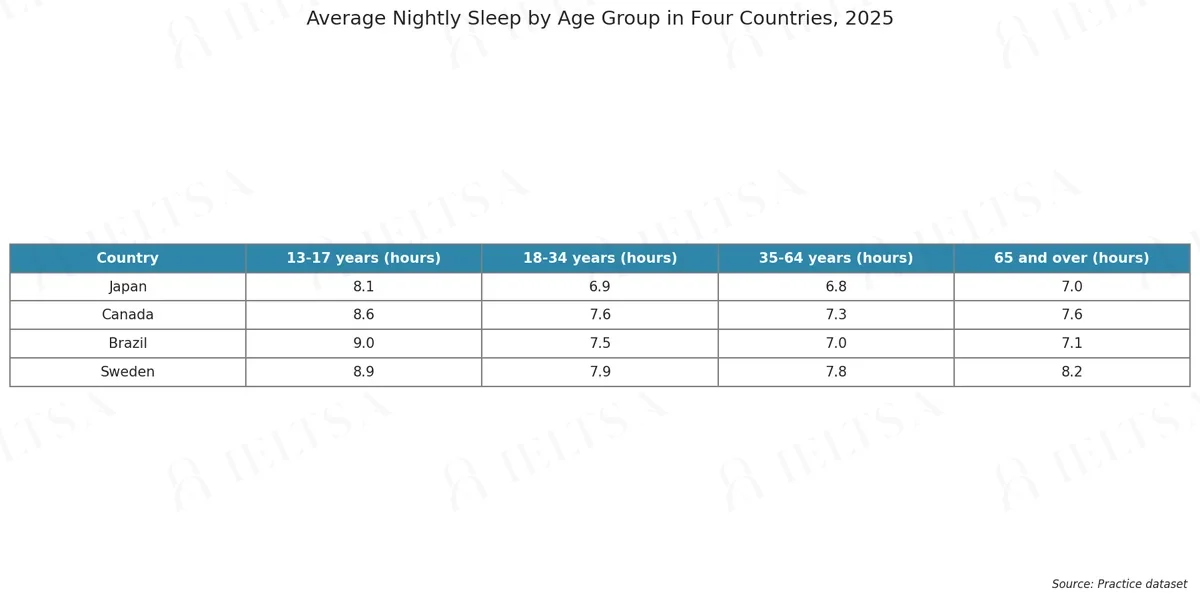
The table below shows the average number of hours of sleep per night for four age groups in four countries in 2025. Summarise the information by selecting and reporting the main features, and make comparisons where relevant.
Write at least 150 words.
Instructions
You should spend about 20 minutes on this task.
• Begin with an overview of the main trends or differences.
• Compare the countries and the age groups with each other as well as over time.
• Use the figures and units shown in the table where they help.
• Do not give your own opinions or speculate about causes.
How to approach this table question
A table packs many numbers into rows and columns. Select the features that matter instead of copying cells.
- Paraphrase the title and say what the rows and columns are.
- Overview: pick two or three clear patterns, such as the highest row and the biggest change.
- Group rows or columns that behave alike.
- Support each point with one or two figures and units.
How to plan this answer
Structure
- Introduction: paraphrase the table, which shows the average hours of sleep per night for four age groups in four countries in 2025.
- Overview: teenagers sleep the most in every country, the 35-64 group sleeps least in every country, and sleep rises again among those aged 65 and over.
- Body paragraph 1: the 13-17 group across the four countries, with Brazil highest at 9.0 hours and Japan lowest at 8.1 hours.
- Body paragraph 2: the adult groups (18-34, 35-64 and 65 and over), where Sweden is highest and Japan is lowest in each column.
Key features to spot
- Japan has the lowest figure in every age group, at 8.1, 6.9, 6.8 and 7.0 hours.
- Sweden has the highest figure among adults in all three adult groups: 7.9, 7.8 and 8.2 hours.
- Brazil's teenagers sleep 9.0 hours, the highest figure in the table, but Brazil's 18-34 group falls to 7.5 hours, a drop of 1.5 hours.
- In all four countries the 35-64 figure is the lowest of the adult groups, and the 65+ figure rises above it again.
- Sweden's over-65s sleep 8.2 hours, a rise of 0.4 hours on the 35-64 group, while Japan's rise is only 0.2 hours.
Useful vocabulary
- average nightly sleep: Average nightly sleep is highest among 13-17 year olds.
- hours per night: Teenagers in Brazil sleep 9.0 hours per night.
- the longest: Teenagers in Brazil have the longest sleep in the table.
- the shortest: Japan's teenagers have the shortest sleep of the four countries.
- fell sharply to: Sleep in Brazil falls sharply to 7.5 hours among 18-34 year olds.
- the lowest figure: The 35-64 group records the lowest figure in each country.
- rose slightly: Sleep rises slightly for people aged 65 and over.
- in every country: The 13-17 group sleeps most in every country.
Common mistakes
- Saying Sweden has the longest sleep among teenagers; Brazil (9.0) is higher than Sweden (8.9).
- Describing the 35-64 dip as a steady decline across all four age groups, when the rise after 65 breaks that pattern.
- Treating the table as showing change over time, when all four columns are for 2025 only.
- Missing that Japan is lowest in every column, which is one of the clearest features of the table.
- Speculating on why teenagers sleep more, which the prompt rules out.
Examiner tip: Find the highest and lowest figure in each column, then check whether a pattern holds across all four countries before writing it up.
Model answers by band score
Written for this question to show what changes from one band to the next. Try the task yourself first, then compare.
Band 6 answer
The table show the average hours of sleep per night for four age groups in Japan, Canada, Brazil and Sweden in 2025.
Overall, teenagers sleep the longest in every country and Sweden have the most sleep for adults. Japan has the least sleep in most groups.
The teenagers from Brazil sleep 9.0 hours, which is the highest figure, and Sweden is 8.9 hours. Canada is 8.6 hours and Japan is 8.1 hours, the lowest for this group. After that, the sleep goes down for people aged 18 to 34 and 35 to 64. For example, Japan is 6.9 and 6.8 hours, and Canada is 7.6 and 7.3.
For the oldest people, aged 65 and over, the hours go up a little in all countries. Sweden has 8.2 hours for this group, while Japan has only 7.0 hours and Brazil has 7.1 hours. Canada is 7.6 hours. In conclusion Sweden has high sleep for all groups and Japan is low, and Brazil is very different between young and old people.
Why this is band 6
- Reports the main pattern (teenagers sleep most, Japan least) and uses real figures from the table, so the content is relevant and mostly accurate.
- Grammar errors recur ('The table show', 'Sweden have', 'sleep goes down') and the verb 'is' is repeated for every figure, which limits the range.
- 'Brazil is very different between young and old people' is vague and overgeneralised; the overview also lacks a precise comparison (for example that Sweden is highest for every adult group).
- Band 7 would give a clearer overview, group figures by pattern instead of listing them, and use more varied comparison language with fewer errors.
Band 7 answer
The table compares the average number of hours that people in four age groups sleep each night in Japan, Canada, Brazil and Sweden in 2025.
Overall, teenagers sleep considerably longer than any other age group in every country, and Sweden has the highest figures for adults while Japan has the lowest.
Among 13 to 17-year-olds, Brazil leads with 9.0 hours, closely followed by Sweden on 8.9 and Canada on 8.6. Japanese teenagers sleep only 8.1 hours, which is still more than any adult group in that country. Sleep then falls sharply for 18 to 34-year-olds, to between 6.9 hours in Japan and 7.9 hours in Sweden.
The 35 to 64 group sleeps least in all four countries, with figures from 6.8 hours in Japan to 7.8 in Sweden. People aged 65 and over sleep slightly more than this middle-aged group, although the increase is small in Brazil (7.0 to 7.1 hours) and Japan (6.8 to 7.0). Sweden's older people record 8.2 hours, the highest figure for any adult group in the table.
Why this is band 7
- Clear overview stating that teenagers sleep most everywhere and that Sweden is highest and Japan lowest for adults, which is accurate against the table.
- Information is organised by age pattern rather than by country, with well-chosen figures and comparisons such as 'still more than any adult group'.
- Good range of structures and vocabulary ('falls sharply', 'closely followed by') with only occasional imprecision.
- Band 8 would make the comparisons more precise (for example giving the gaps between teenagers and adults) and show more natural, flexible phrasing.
Band 8 answer
The table shows how many hours of sleep people in four age groups get per night in Japan, Canada, Brazil and Sweden in 2025.
Overall, teenagers sleep the longest in every country, and sleep drops markedly in adulthood before recovering slightly after 65. Sweden records the longest sleep for every adult group, while Japan records the shortest for all groups.
Brazilian teenagers sleep the most, at 9.0 hours, narrowly ahead of Swedish teenagers (8.9) and Canadians (8.6). Japan's 8.1 hours is the lowest. The sharpest fall occurs between the teenage and 18 to 34 groups: Brazil's figure drops by 1.5 hours to 7.5, and Japan's by 1.2 to 6.9.
Sleep reaches its lowest point among 35 to 64-year-olds in each country, from 6.8 hours in Japan to 7.8 in Sweden. Those aged 65 and over sleep a little longer, although the rise is modest in Brazil (0.1 hours) and Japan (0.2). Sweden has the largest gain, of 0.4 hours, and its older residents average 8.2 hours, more than an hour above their Japanese counterparts at 7.0.
Why this is band 8
- Overview captures two trends (a drop after the teens and a small recovery after 65) and the country ranking, with every claim checking against the table.
- Calculated differences (a 1.5-hour fall in Brazil, 1.2 in Japan, a 0.4-hour gain in Sweden) are accurate and show well-selected, purposeful detail.
- Language is precise and flexible ('narrowly ahead of', 'sharpest fall', 'counterparts') with rare errors.
- Band 9 would integrate the data with still greater economy and avoid slightly list-like sentences such as the series of country figures in paragraph three.
Band 9 answer
The table compares the average nightly sleep of four age groups in Japan, Canada, Brazil and Sweden in 2025.
Overall, teenagers sleep far longer than adults in every country, sleep bottoms out in middle age, and it recovers slightly after 65. Sweden has the longest sleep in every adult group, while Japan has the shortest in all four.
At 9.0 hours, Brazilian teenagers sleep the most, narrowly ahead of Swedish (8.9) and Canadian (8.6) teenagers, with Japan trailing at 8.1. The transition to adulthood brings the steepest decline: Brazil's figure falls by 1.5 hours to 7.5, Canada's by 1.0 to 7.6 and Japan's by 1.2 to 6.9, while Sweden's, also 1.0, leaves it at 7.9, the highest adult figure for that age.
Sleep is shortest for 35 to 64-year-olds everywhere, ranging from 6.8 hours in Japan to 7.8 in Sweden. Older people then gain a little: 0.4 hours in Sweden (to 8.2), 0.3 in Canada (to 7.6), 0.2 in Japan (to 7.0) and a mere 0.1 in Brazil (to 7.1). The gap between the best and worst sleepers in the oldest group is therefore 1.2 hours.
Why this is band 9
- The overview is complete and insightful, giving the U-shaped pattern by age and the stable country ranking in two sentences.
- All calculated differences are correct (for example 9.0 to 7.5 is 1.5; 8.2 minus 7.0 is 1.2) and every one is used to support a point.
- Language is sophisticated and error-free, with varied structures ('bottoms out', 'trailing at', 'a mere 0.1').
- Paragraphs follow the age progression logically, and the closing sentence draws a precise, data-based comparison.
Band levels are our estimate against the public IELTS criteria; they are not official scores.
Write your answer
Sign in with Google to write online and get 8 free answers marked each month against the IELTS band criteria. No card, no password.
Sign in with Google to writeMore practice questions
IELTS Academic Writing Task 1: Crime Statistics Table Analysis
Academic · Task 1 · Crime
Adult Smoking Rates in Four Regions
Academic · Task 1 · Health
IELTS Academic Writing Task 1: Technology Adoption Rates Table
Academic · Task 1 · Technology
Rents and Home Prices in Four Cities
Academic · Task 1 · Housing
Practise all four IELTS skills
Listening, Reading, Writing and Speaking with band 8 samples at ieltsa.org.