Visitor Spending at a Music Festival
The question
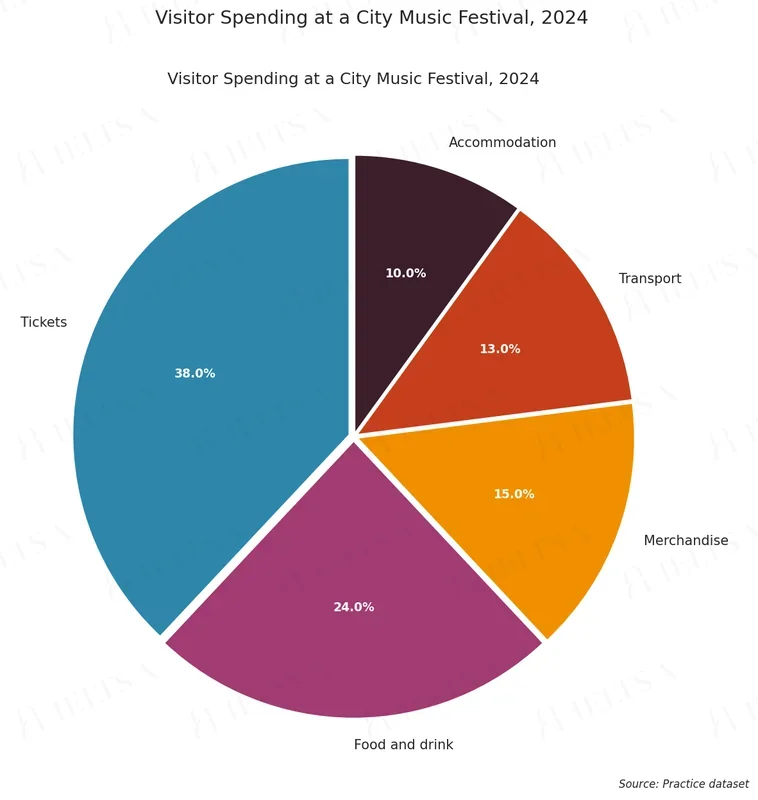
The pie chart below shows how visitors spent their money at a city music festival in 2024. Summarise the information by selecting and reporting the main features, and make comparisons where relevant.
Write at least 150 words.
Instructions
You should spend about 20 minutes on this task.
• Begin with an overview of the main trends or differences.
• Compare the largest and smallest categories.
• Use the percentages shown on the chart where they help.
• Do not give your own opinions or speculate about causes.
How to approach this pie chart question
Pie charts show proportions of a whole. With two pies, the task is to describe how the shares changed or differ.
- Say what the whole is and what the percentages measure.
- Overview: the biggest share and the main shift between charts.
- Compare the largest slices first, then the smallest.
- Use fractions and percentages (just over a third, roughly 20%).
How to plan this answer
Structure
- Introduction: paraphrase the pie chart, which shows how visitors spent their money at a city music festival in 2024 across five categories.
- Overview: tickets take the largest share at 38%, accommodation is the smallest at 10%, and food and drink is the second-largest category.
- Body paragraph 1: the two largest categories, tickets (38%) and food and drink (24%), and their combined share.
- Body paragraph 2: the three smaller categories, merchandise (15%), transport (13%) and accommodation (10%), and how they compare with the largest slice.
Key features to spot
- Tickets account for 38%, which is 14 points more than food and drink (24%).
- Tickets and food and drink together make up 62%, roughly three-fifths of spending.
- Merchandise, transport and accommodation are close together at 15%, 13% and 10%, and their combined share (38%) equals the ticket share alone.
- Tickets are nearly four times the size of accommodation (38% against 10%), the smallest slice.
- The five slices total 100%, so the shares can be checked against one another.
Useful vocabulary
- accounted for: Tickets accounted for 38% of visitor spending.
- the largest share: Tickets had the largest share of spending.
- a fraction of: Accommodation was a fraction of the size of ticket spending.
- combined: Food and drink combined with tickets makes up 62% of spending.
- the smallest proportion: Accommodation had the smallest proportion of spending at 10%.
- just over: Merchandise took just over a seventh of spending.
- in comparison: In comparison, transport accounted for 13%.
- the remaining categories: The remaining categories each took less than a quarter of spending.
Common mistakes
- Describing the figures as money amounts, when the pie shows percentage shares of total spending.
- Calling transport 'much smaller' than merchandise; the gap is only 2 points (13% against 15%).
- Listing all five slices in full instead of grouping the smaller categories.
- Quoting the accommodation share as 'a fifth' or similar rounding that misstates the 10% figure.
- Speculating about why visitors spent more on tickets, which the prompt does not allow.
Examiner tip: Lead with the largest slice, contrast it with the smallest, and use combined shares to add interest without repeating every figure.
Write your answer
Sign in with Google to write online and get 8 free answers marked each month against the IELTS band criteria. No card, no password.
Sign in with Google to writeMore practice questions
Practise all four IELTS skills
Listening, Reading, Writing and Speaking with band 8 samples at ieltsa.org.